
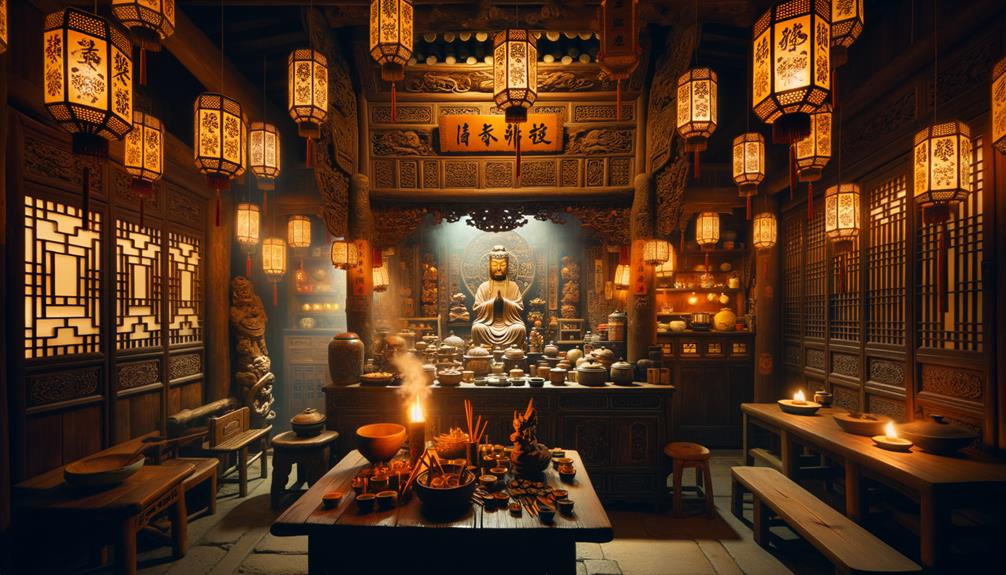
Zao Jun (灶君), the Kitchen God, is a household deity whose position near the stove links daily family life with the wider sacred order. He is often imagined as an observer of conduct who reports to heaven near the end of the lunar year. Customs differ by region, period, and household, so neither one origin story nor one New Year procedure applies everywhere.
The sacred center of the household
For much of Chinese history, the stove was more than an appliance. It transformed raw food, warmed the home, and gathered family members around recurring work. A paper image or tablet for the Kitchen God could be installed above or near this space. Popular prints may show Zao Jun with his wife, attendants, a celestial court, or jars recording good and bad actions.
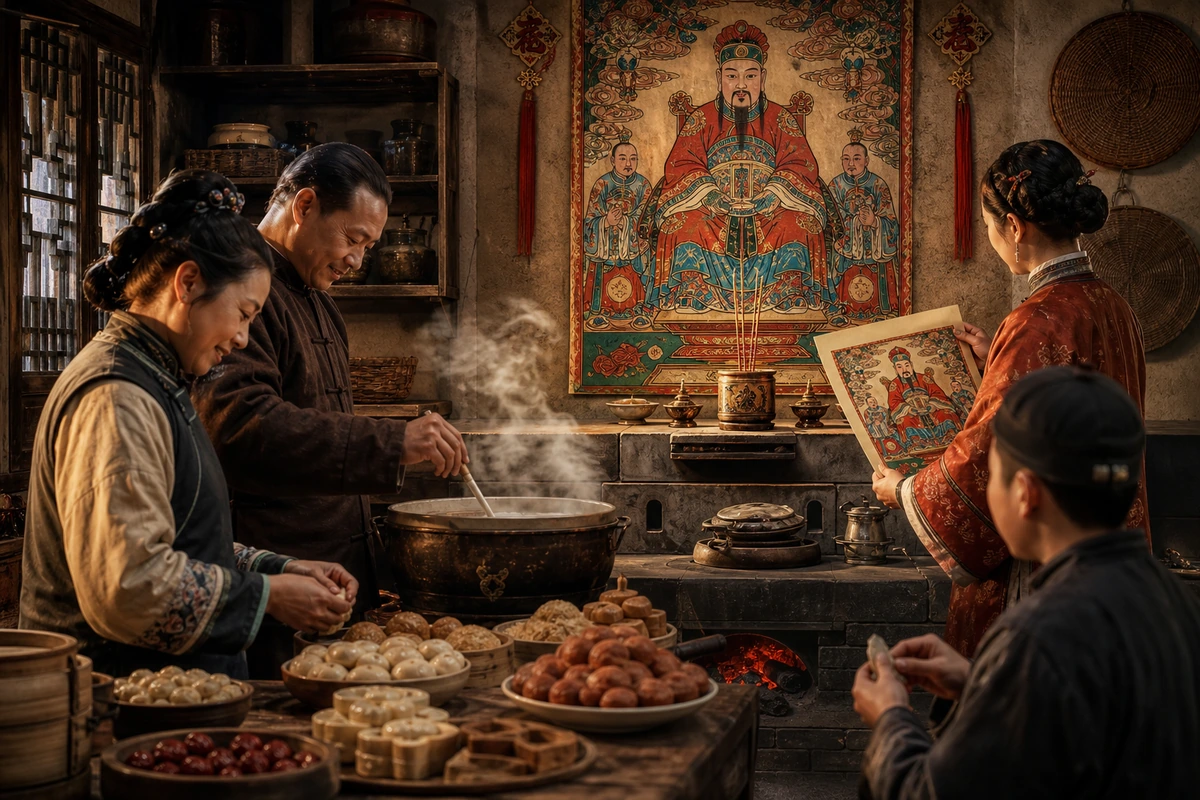
The British Museum preserves a nineteenth-century New Year print of Zao Jun and his wife. Its imagery demonstrates that the tradition was not limited to an abstract idea: inexpensive printed pictures gave the household deity a visible place in domestic ritual.
The annual journey to heaven
In many communities, the Kitchen God is sent to heaven during the final days of the lunar year to report on the household. An old paper image may be ceremonially removed and burned so that the deity can ascend; a fresh image is installed for the coming year. Exact dates and sequences vary.
Offerings often include sweet foods. A playful explanation says that sweetness encourages a favorable report—or makes the god’s mouth too sticky to speak harshly. The offering can also express gratitude, respect, and hope for family harmony. Reducing it to a bribe misses the broader ritual of farewell and renewal.
Stories about Zao Jun’s mortal life
One widespread tale calls the future Kitchen God Zhang Lang. After abandoning a devoted wife, he loses his fortune and eventually encounters her again. Overcome by shame, he dies near the hearth and is later appointed to watch over households. Details change: some versions emphasize repentance, others fidelity or the consequences of waste and selfishness.
Other traditions do not give Zao Jun this biography at all. The deity may instead emerge from older sacrificial relationships with the stove. Calling the Zhang Lang narrative “the” origin would therefore make a variant sound universal.
Observation, morality, and renewal
The Kitchen God brings ethics into an ordinary room. Family behavior is not hidden simply because it happens at home; hospitality, waste, quarrels, care, and honesty all take place under sacred observation. At New Year, the removal and replacement of the image marks both accountability and the possibility of a fresh start.
Zao Jun’s household jurisdiction differs from Tu Di Gong’s local guardianship and Zhong Kui’s protective role. Their overlapping presence shows how Chinese popular religion can organize divine responsibilities by place and need rather than insisting on one exclusive protector.