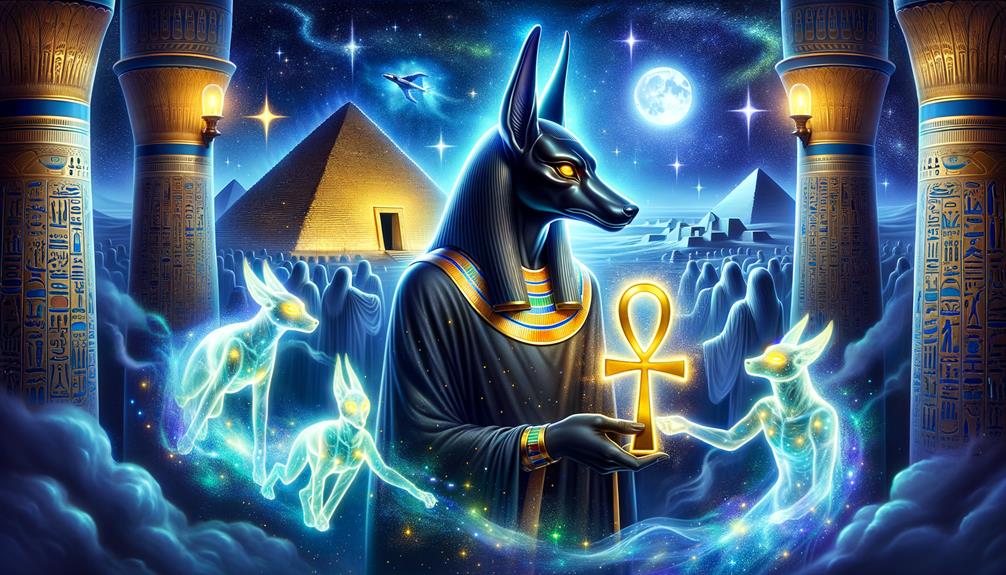
Anubis is the Greek form of the Egyptian god called Inpu or Anpu in modern transliteration. He was closely associated with cemeteries, embalming, the protection of the dead, and funerary rites. Images usually show him as a reclining black canid or as a man with a canid head. Calling the animal a jackal is conventional, but the exact species represented is uncertain.
Anubis Before Osiris
Anubis appears in some of Egypt’s earliest funerary texts. In the Old Kingdom Pyramid Texts he protects and tends the royal dead. He could bear titles such as “He Who Is upon His Mountain,” referring to his command of the desert cemetery, and “Foremost of the Westerners.” The west was associated with burial because many cemeteries lay on the desert’s western edge.
As the cult of Osiris became central to funerary religion, Osiris took the leading position as ruler and judge of the dead. Anubis did not disappear. His role became more focused on embalming, protection, and the successful presentation of the deceased before Osiris.
Anubis and Mummification
Funerary art shows Anubis attending a body on a lion-shaped embalming bed. In the mythic pattern centered on Osiris, Anubis helps prepare Osiris’s body after his murder. This made the god a divine model for embalmers and for the rituals that transformed a corpse into a protected, effective dead person.
Priests connected with embalming could be identified with Anubis. Some ritual scenes depict a human officiant wearing a canid mask. Anubis was also invoked during rites such as the Opening of the Mouth, which restored the deceased person’s ritual ability to breathe, eat, speak, and receive offerings.
Anubis at the Weighing of the Heart
In illustrated versions of Book of the Dead Spell 125, Anubis usually tends or checks the balance. The deceased person’s heart is weighed against the feather or emblem of Maat, the principle of truth and right order. Thoth records the result, Osiris presides, and Ammit waits to consume a heart that fails the test.
Anubis is therefore essential to the judgment scene, but he is not usually its sole judge. The image does not show a physical weighing performed by embalmers. It represents a judgment expected to take place in the next world.
Why Is Anubis Black?
The black color is symbolic. Natural jackals and related canids are not solid black. In Egyptian art, black could evoke the darkened appearance of a prepared body and the fertile Nile silt associated with regeneration. The color links Anubis with death and with the renewal hoped for after death.
Was Anubis a Guide of Souls?
Greek and Roman writers emphasized Anubis as a conductor between worlds, and the Greeks compared him with Hermes. Egyptian funerary sources more often stress his work as protector, embalmer, and official at judgment. “Guide of the afterlife” is a useful summary, but stories about Anubis leading every soul through a maze are modern elaborations rather than a standard ancient narrative.
Anubis’s Family
There is no single family tree valid for every period. Later traditions can make Anubis the son of Osiris and Nephthys, while other texts connect him with the cow goddess Hesat or identify his mother differently. Egyptian theology could change by temple, period, and ritual setting.
Frequently Asked Questions
Was Anubis the Egyptian god of death?
That label is too broad. Anubis governed embalming, cemeteries, protection, and parts of judgment. Osiris was the principal ruler of the dead in the best-known later funerary tradition.
Did Anubis invent mummification?
Myths and ritual images give him the divine role of embalmer, especially for Osiris. That religious claim is not a historical account of how the human practice developed.
Is Anubis evil?
No. He protects the body, supervises correct ritual, and helps uphold Maat. His connection with death does not make him an enemy of the deceased.