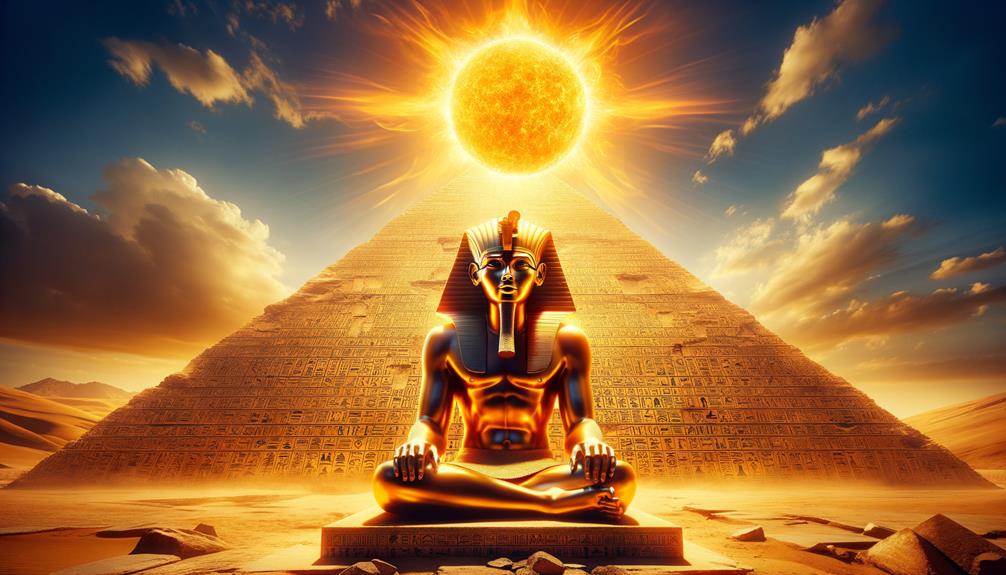
Ra, also written Re, was the ancient Egyptian sun god and one of the central divine powers associated with creation and kingship. Egyptian religion changed across more than three millennia, so Ra did not have one fixed biography or family tree. He was worshipped in several forms and combined with other gods without losing his solar identity.
Ra and the Sun
Ra’s principal cult center was Iunu, called Heliopolis in Greek. Heliopolitan creation traditions describe the sun god, often as Ra-Atum, emerging from the primeval waters and beginning the generations of gods. These traditions coexist with other Egyptian creation accounts centered on deities such as Ptah or Khnum.
The sun’s daily movement expressed creation renewed. Ra crossed the day sky in a solar boat and travelled through the night world before rising again. In funerary texts he confronts the serpent Apophis, a force of disorder. The struggle is repeated, not ended by one permanent victory.
Ra and Egyptian Kingship
Ra became especially prominent in royal religion during the Old Kingdom. Fifth Dynasty rulers built sun temples, and “Son of Ra” became a standard element of royal titulary. The title linked the reigning king to solar creation and divine order. It did not mean that every king was described by one literal birth story.
How Ra Was Depicted
Ra can appear as a falcon-headed man wearing a sun disk encircled by a rearing cobra. He can also appear as the sun disk, a ram-headed night form, a scarab associated with morning renewal, or through composite gods. Context and inscriptions are essential because a falcon head or sun disk can also belong to other deities.
- Khepri: A scarab form associated with the rising sun and coming into being.
- Ra-Horakhty: A union of Ra with Horus of the Horizons.
- Ra-Atum: A solar creator form linked with Heliopolis and the evening sun.
Composite Forms
Egyptian gods could be joined in composite names to express related powers. Amun-Ra joins Amun’s hidden and universal character with Ra’s solar force. Ra-Horakhty joins the sun with Horus as ruler of the horizons. Funerary texts can also unite Ra and Osiris as complementary powers of daily renewal and the world of the dead.
This process is often called syncretism. It is not evidence that priests were confused about the gods. The combinations allowed several aspects of divine power to be expressed at once.
The Eye of Ra
The Eye of Ra is both Ra’s power and a divine figure who can act independently. Different texts associate the Eye with goddesses including Hathor, Sekhmet, Tefnut, and Bastet. Stories of the Eye can describe protection, royal authority, anger, departure, and return. There is no stable group of exactly three “daughters of Ra” that explains every version.
Ra’s Secret Name
In the story often called “Isis and the Name of Ra,” Isis creates a serpent whose bite makes the aged sun god reveal his hidden name so that she can heal him. The text emphasizes the power of secret knowledge. It does not preserve that ultimate name for the reader.
Did Ra Have a Wife?
Ra has no single wife across all periods and places. Hathor, Iusaaset, Nebethetepet, and other goddesses can be linked with the Heliopolitan creator, while different texts describe different divine relationships. A one-line family tree flattens a religion that varied by temple and period.
Frequently Asked Questions
Was Ra the only Egyptian sun god?
No. Egyptian texts distinguish and combine several solar forms, including Khepri, Atum, Horakhty, Amun-Ra, and the Aten.
Was Apophis a demon?
Apophis was the great serpent enemy of the solar order. Calling him a “demon” can be convenient, but it imports a later category that does not fully match his place in Egyptian religion.
Did Christianity immediately end Ra’s worship?
No single event ended it. Egyptian temple religion changed under Greek and Roman rule and declined over centuries in Late Antiquity. Ra’s importance had also shifted long before that period as solar and funerary traditions developed.
Sources
- UCL Digital Egypt, creation traditions and the sun god
- UCL Digital Egypt, divine names, iconography, and composite gods
- The Metropolitan Museum of Art, Egypt in the Old Kingdom