
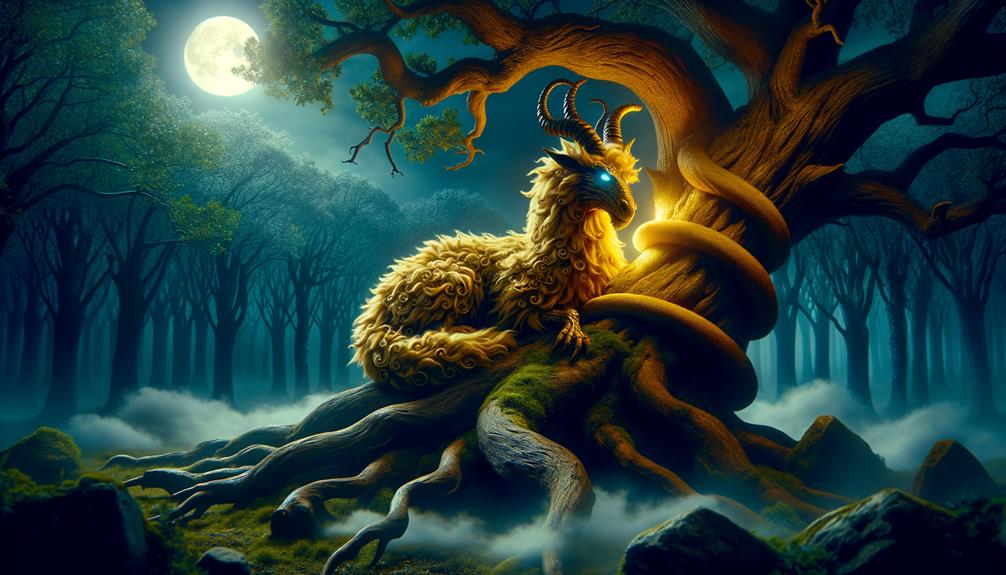
The Golden Fleece myth captivates our imagination with Jason's audacious quest. While Odysseus' exploits are legendary, Jason's adventure stands formidable in its depths. His pursuit symbolizes more than bravery; it explores the intricate bonds between destiny and divine influence. With Hera's guidance and Medea's sorcery, Jason braves treacherous realms and mythical beasts, each obstacle testing human resilience and celestial favor. The Fleece epitomizes sovereignty, yet its significance unveils deeper narratives about heroism's complexities and betrayal's scars. Let's delve into this rich tapestry woven with layers upon layers.
Origins of the Golden Fleece

The legend of the Golden Fleece kicks off with a miraculous ram sent by the gods to rescue Phrixos and Helle from their wicked stepmother, igniting a chain of events that would forever shape Greek mythology. This divine ram carried the siblings away, though tragically, only Phrixos survived the journey. Upon reaching Colchis, he sacrificed the ram to honor the gods, dedicating its golden fleece to Ares, guarded by a fierce serpent.
This fleece wasn't merely a treasure; it symbolized divine authority and kingship, embodying themes of power and ambition. It became the focal point of Jason's fabled quest, a mission imposed by Pelias, who craved the throne. Jason, leading the Argonauts, ventured on this perilous journey to retrieve the Golden Fleece from King Aeetes of Colchis.
Here, the narrative deepens with Medea, the king's daughter, whose involvement would intertwine fate, love, and betrayal. The fleece, thus, stands as a testament to human endeavor and divine intervention. Its mythological legacy extends beyond mere heroism, reflecting the darker aspects of ambition and the complex interplay between mortal and divine realms.
Jason's Quest for the Fleece

Jason's quest for the Golden Fleece sparked as a proving ground for his royal blood – a pathway to the throne of Iolcos. This journey thrust him into a realm where valor and divine favor sealed fates. Pelias, the usurper king, saw an opportunity to eliminate Jason by assigning him a daunting task veiled as a noble venture.
Undeterred, Jason assembled a crew of extraordinary heroes dubbed the Argonauts. Each brought unique strengths, vital for conquering the challenges ahead. Their prize? The Golden Fleece – a tangible symbol of kingship blessed by the gods themselves.
This prized relic resided in distant Colchis under King Aeetes' watchful eye. To claim it, Jason braved a gauntlet of imposing trials. Guided by the watchful Hera, Jason journeyed to Colchis, acquiring an unlikely ally in Medea, Aeetes' daughter, whose magical expertise and love for Jason shifted the scales.
Aeetes crafted tests not mere obstacles but litmus papers of Jason's worth. With Medea's enchantments, Jason conquered fire-breathing bulls, overcame a dragon's teeth curse, and slayed the sleepless dragon guarding the Fleece. Triumphantly seizing the prize, Jason solidified his legendary status and sealed the gods' favor – proof of his rightful claim to power.
The Argonauts' Adventures

Casting off on their legendary voyage, Jason and the Argonauts confronted a series of epic challenges that cemented their place in Greek mythology. This daring crew steered the Argo in pursuit of the Golden Fleece, guarded by King Aeetes in Colchis. Their quest faced hurdles both physical and metaphorical.
- Fire-breathing bulls: With Medea's sorcery and Hera's backing, Jason managed to bridle these formidable beasts.
- Stone warriors: Born from dragon's teeth sown in the earth, these soldiers fell prey to Jason's cunning tactics.
- Treacherous seas: The Argonauts navigated perilous waters, symbolic of life's unpredictable, uncontrollable forces.
- Hera's aid: The goddess provided divine intervention, highlighting the gods' pivotal role in heroic quests.
Each challenge pushed the Argonauts' strength, intelligence, and unity to the brink. Subduing the fire-breathing bulls, for instance, demanded fortitude beyond mere physicality. Through Medea's magic and Jason's determination, their triumph exemplified the synergy of human resilience and celestial favor required for greatness. Ultimately, their successful retrieval of the Golden Fleece remains an enduring emblem of heroism and divine blessing.
Role of Medea

Medea's role is pivotal in Jason's quest, often brushed aside yet indispensable. Without her magical prowess and strategic mind, Jason's journey would have faltered. Medea's love for Jason compelled her to betray her own family, highlighting her intense feelings and willingness to manipulate events in his favor.
Her intelligence shone through devising plans to overcome seemingly insurmountable obstacles, from taming fire-breathing bulls to outsmarting a dragon. Yet, Medea's story serves as a cautionary tale. Her love morphed into a destructive force when Jason sought another bride, prompting her harrowing act of revenge that left a trail of devastation.
Medea's mythical narrative symbolizes the perilous power of unchecked emotions and the complexities of human nature. Her actions remind us of love and betrayal's double-edged sword. The tale explores manipulation, revenge, and the dark recesses of the human psyche, delving deeper than just aiding Jason's quest.
Legacy of the Myth

The Greek myth of the Golden Fleece remains a compelling story, touching on themes of ambition, power, and the human drive for success. This ancient tale speaks to our motivations and fears, serving as both an inspiration and a cautionary tale. The symbolism within the myth resonates deeply – the Golden Fleece represents ultimate wealth and authority, while Medea embodies the intense emotions and drastic actions that love and betrayal can fuel.
The Golden Fleece's impact echoes through various aspects of contemporary culture:
- Writers draw from Jason's quest and Medea's complex character for literary works.
- Artists capture the myth's drama and symbolism in paintings and sculptures.
- The story gets retold, adapted, and reimagined across diverse mediums.
- Themes of betrayal and vengeance reverberate in modern storytelling.
The myth's enduring popularity underscores its universal resonance and profound influence on the collective imagination. It reminds us that the pursuit of power often carries grave consequences, shaping literature, art, and cultural narratives for generations to come.
Frequently Asked Questions
What Is the Moral of the Golden Fleece?
The story serves as a cautionary tale against deception and greed. It demonstrates how betraying trust and prioritizing selfish gains can lead to tragic outcomes. At its core, the tale underscores the importance of integrity, loyalty, and considering the consequences of one's actions. Through its narrative, it highlights the destructive nature of revenge and warns against sacrificing moral principles for personal gain.
What Is the Golden Fleece Summary?
The Golden Fleece represents the pinnacle of power and ambition. Jason's arduous journey, guided by Medea, mirrors the archetypal hero's trials. He confronts betrayal and triumph, reflecting humanity's eternal pursuit of validation and destiny's call.
What Happened When Jason Got the Golden Fleece?
When I secured the Golden Fleece, triumph rushed through my veins, yet apprehension lingered. The mythical prize, an emblem of power and prosperity, marked the beginning of a treacherous path marred by betrayal and heartbreak – a harsh reminder that ambition and love often demand heavy tolls.
Which Hero Is the Golden Fleece in Greek Mythology?
The Golden Fleece doesn't depict a hero; it's a symbolic object representing power and leadership. Jason's quest to retrieve it chronicles an adventurous journey where ordinary individuals overcome tremendous obstacles, ultimately achieving legendary status. Undertaking such mythical voyages often transforms people in profound ways, leaving behind their everyday selves.