

The Ruyi Jingu Bang is Sun Wukong’s shape-changing staff in the Chinese novel Journey to the West. It is not a historical relic recovered from antiquity, but a literary object whose impossible weight, responsive size, and origin in the Dragon King’s treasury establish the Monkey King’s strength before his rebellion against Heaven. Modern adaptations often call it the “golden cudgel,” “compliant golden-hooped rod,” or simply Wukong’s staff.
What does the name Ruyi Jingu Bang mean?
The name is written 如意金箍棒. Ruyi conveys “as desired” or “according to one’s wish,” fitting an object that adjusts to its owner’s command. Jingu refers to its golden bands or hoops, and bang is a staff or cudgel. English translations vary because a compact Chinese name can be rendered literally, functionally, or poetically. The central idea remains a gold-banded iron staff that complies with Sun Wukong’s will.
How Sun Wukong obtains the staff
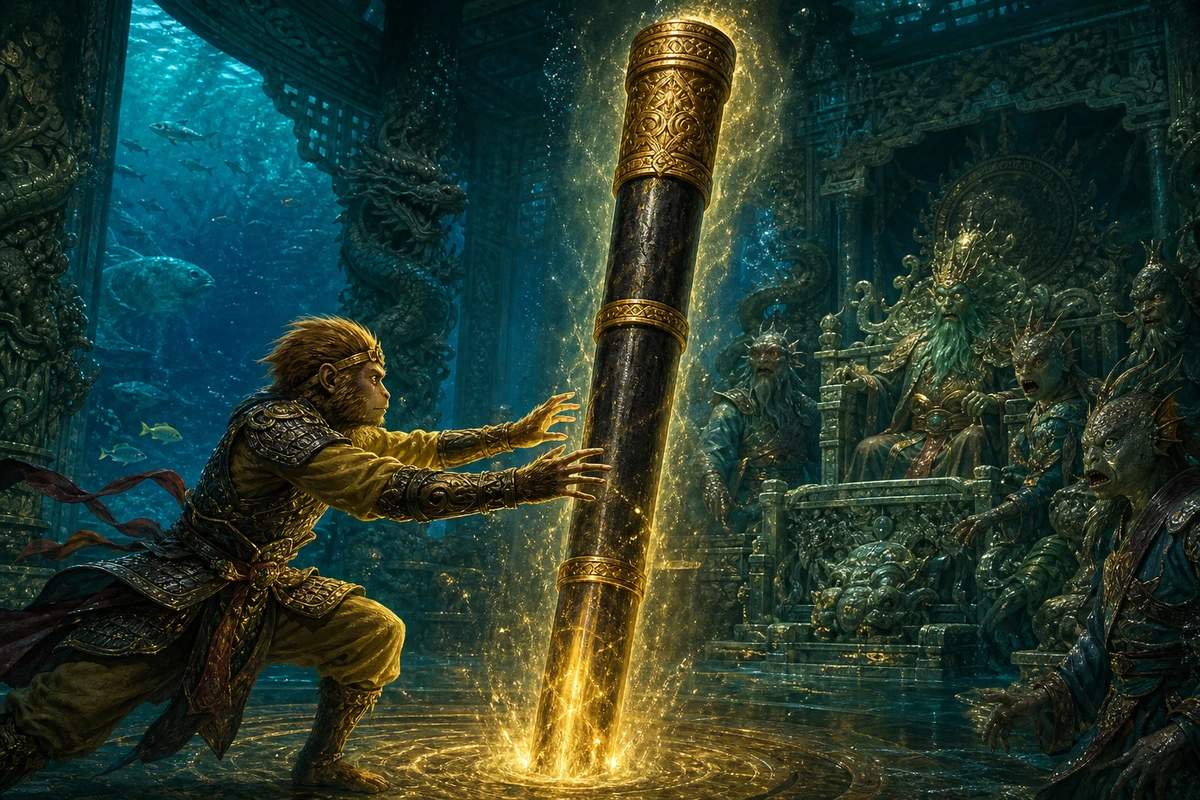
The episode appears in chapter 3 of the sixteenth-century novel. Having learned supernatural arts and armed the monkeys of his mountain, Wukong decides that an ordinary weapon is too light for him. He travels beneath the Eastern Ocean to the palace of Ao Guang, the Dragon King of the East Sea, and demands something worthy of his power.
The Dragon King offers a succession of weapons, including a great sword and heavy martial arms. Wukong handles them easily and dismisses them as too light. The frightened dragon court then remembers that a pillar of divine iron in the treasury has begun to glow. Wukong approaches it and senses that the object suits him. When he wishes it smaller, it contracts; when he wishes it shorter, it responds again. What had looked like part of the palace becomes a usable staff.
The staff bears an inscription naming it and giving its weight as 13,500 catties. The novel uses that number as magnificent hyperbole: Wukong can wield what no normal fighter could lift. A catty is a traditional unit whose exact value has differed by period and place, so converting the inscription into one precise modern weight can create false accuracy.
The staff’s origin inside the story
According to the Dragon King’s explanation, the iron had once been used by Yu the Great when the ancient culture hero ordered or measured the waters. It then remained in the Eastern Ocean as a stabilizing or measuring object until Wukong claimed it. This connection gives the staff cosmic and civilizing associations inside the novel, but it should not be mistaken for evidence that Chinese archaeology or early historical texts document a physical Ruyi Jingu Bang.
| Feature | What the novel establishes | Common exaggeration to avoid |
|---|---|---|
| Material | Divine black iron marked by golden bands | A staff made entirely of gold |
| Weight | The inscription states 13,500 catties | A single exact conversion into modern pounds or kilograms |
| Size | It grows and shrinks according to Wukong’s wish | It is merely a normal staff hidden by illusion |
| Storage | Wukong reduces it to needle size and keeps it in his ear | The ear itself is a magical container independent of the staff |
| Origin | The Dragon King links the iron to Yu the Great within the novel | A claim that the weapon is an authenticated historical artifact |
Can it change weight as well as size?
The text repeatedly emphasizes changes of length and thickness. The staff can become tiny enough to store in Wukong’s ear, return to fighting size, or expand to match his gigantic transformed body. The famous inscription continues to give its extraordinary weight. It is therefore more accurate to say that the staff changes size at Wukong’s command than to claim the novel clearly describes a separate power to make its mass light or heavy.
This distinction sharpens the joke and the feat. The miniature staff remains the same impossible weapon in compressed form, while Wukong’s strength allows him to swing it casually. Its obedience also contrasts with the fixed weapons the Dragon King first presents: only the responsive pillar is truly suited to a being who refuses ordinary limits.
What powers does the Ruyi Jingu Bang have?
- Responsive size: it contracts to needle size or expands to enormous dimensions at Wukong’s command.
- Durability and force: its divine material and stated weight make it a devastating close-combat weapon.
- Proportional transformation: when Wukong enlarges his own body, the staff can enlarge with him.
- Convenient concealment: when he is not fighting, he commonly stores the tiny staff in his ear.
Some battle scenes involve Wukong’s hairs becoming copies, helpers, or transformed objects. Adaptations sometimes transfer those abilities directly to the staff or give the weapon new elemental attacks. Such versions can be entertaining, but they should not be treated as a single fixed list of powers from the novel.
Why the Dragon King episode matters
The acquisition scene introduces more than an iconic prop. Wukong enters another ruler’s domain, rejects every conventional gift, and leaves with the treasury’s greatest object. He then pressures the other dragon kings for armor. The sequence displays confidence, comic audacity, physical power, and disregard for cosmic hierarchy—the same traits that soon bring him into conflict with the bureaucracy of Heaven.
The staff also joins several scales of the novel’s world. It connects the age of Yu the Great, the underwater dragon courts, Wukong’s mountain kingdom, and the later Buddhist pilgrimage. Once the journey begins, a symbol of unruly strength becomes one of the tools used to protect the monk Tang Sanzang. The weapon does not become tame, but its force is redirected toward a demanding spiritual task.
Ruyi Jingu Bang in later culture
Opera, animation, comics, games, film, and television have repeatedly redesigned the staff. Its most recognizable visual formula remains a dark or red shaft capped or banded with gold. In Japan, its name is commonly read as Nyoi-bō; the extending Power Pole used by Son Goku in Dragon Ball is an explicit descendant of Wukong’s weapon. Many later heroes carry telescoping staffs, but not every magical rod is intended as the same artifact.
For the original episode, readers can compare the Chinese text in the Chinese Text Project’s chapter 3 with an English rendering in “The Dragon King of the Eastern Sea”. Translation choices differ, but both preserve the comic escalation from weapons that are too light to the iron pillar that answers Wukong’s wish.
The Ruyi Jingu Bang endures because its mechanics express its owner’s character. It is impossibly heavy yet effortlessly handled, ancient yet claimed by an upstart, and vast yet hidden as a needle. Rather than being decorative equipment, it makes Wukong’s refusal to remain one fixed size, rank, or role physically visible.