
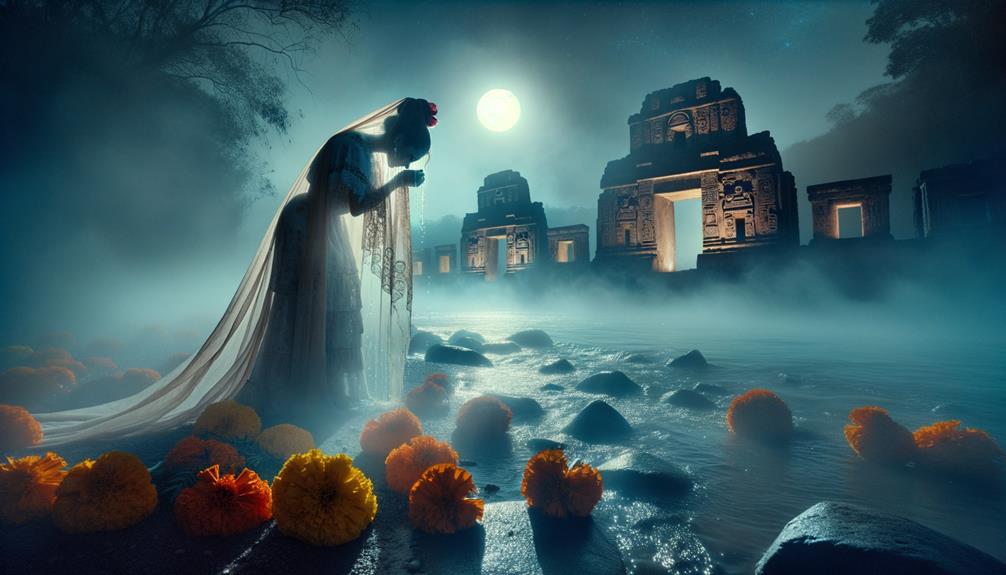
La Llorona, the Weeping Woman, is a widespread legend in Mexico, the United States, and other parts of Latin America. The story has many local versions and no single proven origin or real historical woman.
La Llorona in the surviving tradition
A common form tells of a mother who loses or kills her children and wanders near water crying for them. In some tellings she harms children or travelers; in others she warns people away from danger. Names, motives, family background, and ending change by region and teller.
Texts, objects, and evidence
Writers have compared La Llorona with colonial Mexican stories, Indigenous female omens, Spanish tales of wandering women, Catholic ideas about restless souls, and the historical figure Malintzin. These comparisons illuminate later meanings but do not establish that one pre-Columbian goddess simply became La Llorona. Printed versions and film have also standardized details that were once fluid.
Key points
- The cry: A cry for her lost children is the best-known line, though wording varies.
- Water: Rivers, canals, ditches, and lakes give the legend a setting tied to danger and boundaries.
- Moral use: Adults may tell the story to warn children away from water or nighttime travel.
- Cultural meanings: The legend has been used to discuss motherhood, gender, conquest, migration, grief, and social violence. No one interpretation cancels the others.
How to read the material
Presenting the legend as a verified true crime or naming a precise date invents certainty. Folklore survives through variation.