Shennong (神農), the “Divine Farmer,” is a Chinese culture hero associated with agriculture, medicinal substances, markets, and the transition to an ordered settled life. Traditional chronologies place him in deep antiquity and sometimes identify him with the Yan Emperor. The relationships among these names vary across texts, so Shennong cannot be reconstructed as a modern historical biography.
The teacher of cultivation
Classical traditions credit Shennong with shaping wood into agricultural tools, teaching people to cultivate grain, and establishing markets at midday. These stories gather several foundations of society around an exemplary ancestor: reliable food, specialized labor, and exchange between communities.
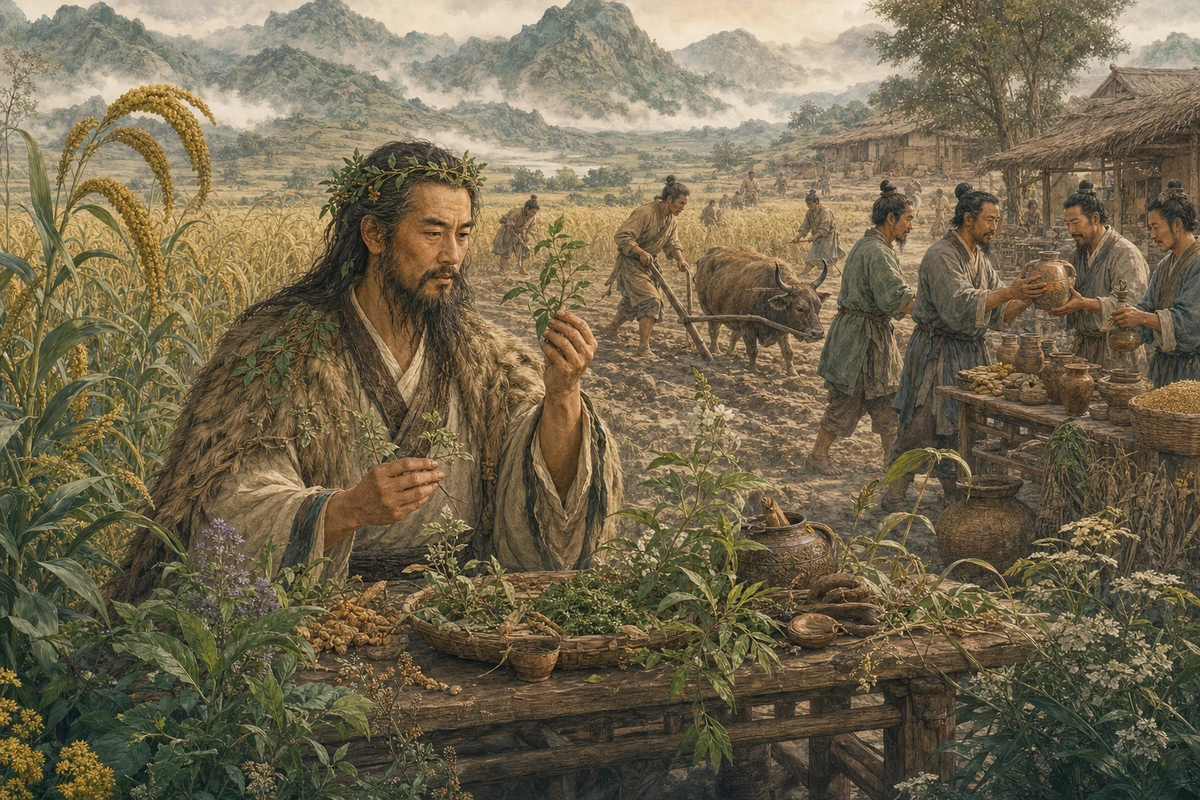
Agriculture in ancient China did not begin with one sudden invention. Archaeology traces long histories of plant domestication, regional crops, settlement, and tool use. Shennong’s importance is symbolic: the Divine Farmer represents accumulated knowledge made beneficial to a community.
Tasting hundreds of plants
The most famous medical legend says Shennong personally tasted many plants to learn their properties, encountering numerous toxic substances in the process. Later images may give him an ox-like head, horns, leaf-covered clothing, or a transparent abdomen through which he observes a plant’s effects. These are iconographic and narrative signs of extraordinary knowledge, not anatomical claims.
Tea is sometimes said to rescue Shennong from poisoning, but versions differ and the familiar anecdote should not be used as a secure date for tea drinking. More broadly, a sacred tasting story does not validate a modern treatment. Plants can contain active and dangerous compounds; historical tradition and medical efficacy require different kinds of evidence.
The book attributed to Shennong
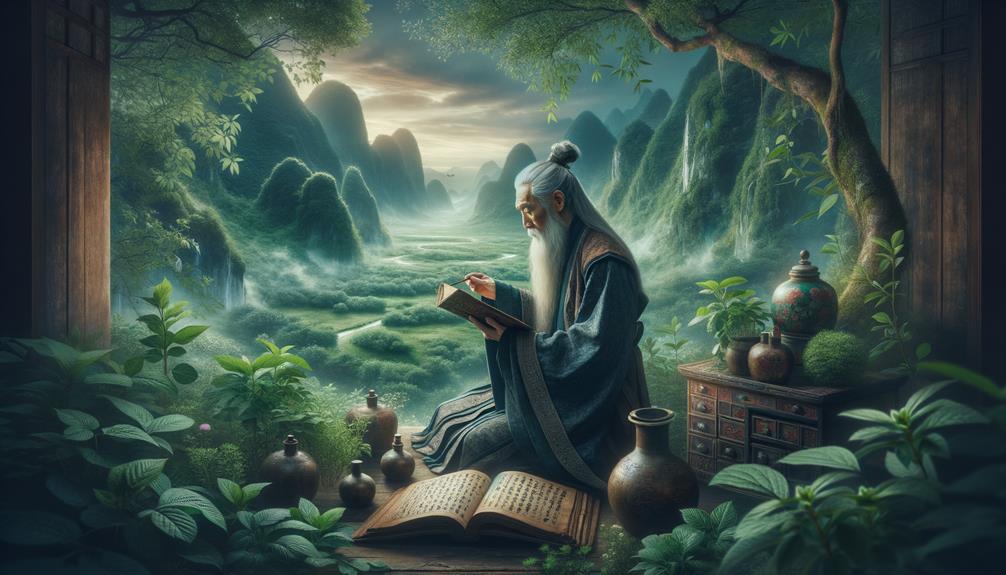
The Shennong bencao jing, or Divine Farmer’s Classic of Materia Medica, is a foundational Chinese work on medicinal substances. It lists hundreds of materials from plants, animals, and minerals and organizes them by perceived properties and uses. The text was compiled many centuries after the era assigned to the legendary Shennong, and its true authorship is unknown.
Attaching Shennong’s name gave the work ancestral authority; it does not mean a prehistoric emperor personally wrote the surviving text. The distinction between traditional attribution and historical authorship is essential when discussing early medical literature.
Shennong among other healing traditions
Shennong’s plant lore differs from the later temple cult of Baosheng Dadi, whose identity is associated with the memory of the Song-period healer Wu Ben. Shennong also belongs beside Leizu and Cangjie as a culture hero who personifies knowledge developed collectively.