
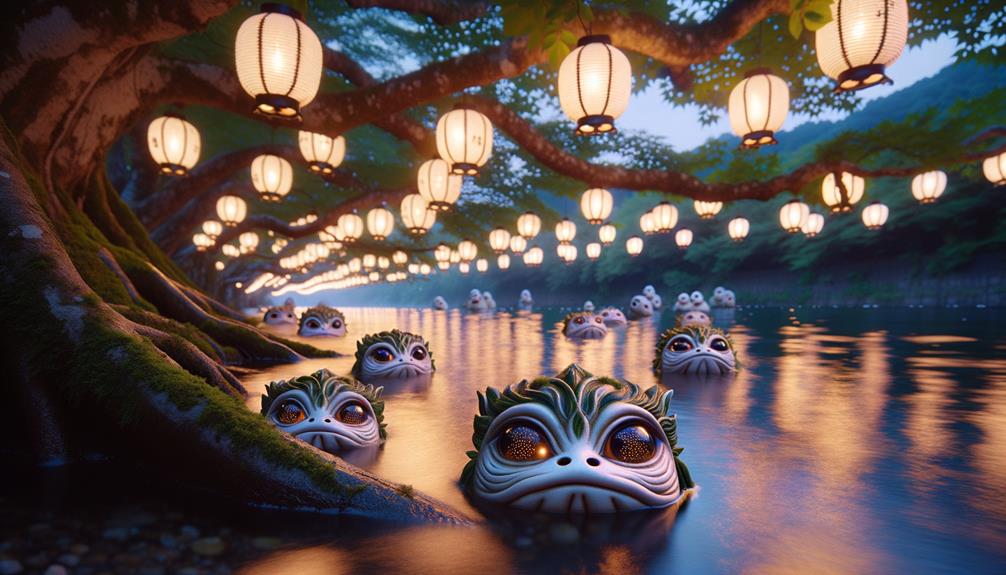
Kappa are among the best-known water beings in Japanese folklore. They are associated with rivers, ponds, irrigation channels, and other dangerous waters, but there is no single national biography. Regional names, appearances, and stories differ. Some kappa drown people or animals; others bargain, keep promises, share knowledge, or become comic mascots.
Names and appearances
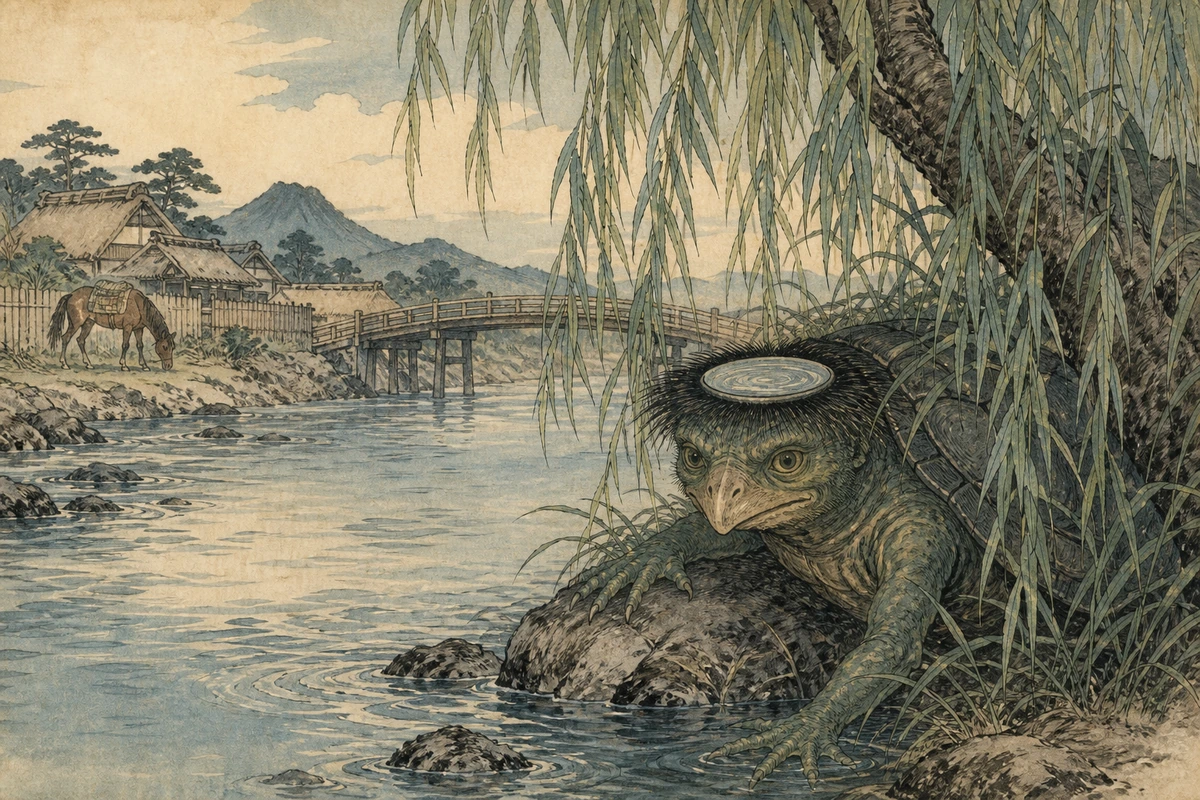
The familiar modern kappa is small and amphibious, with a beak, webbed hands and feet, a turtle-like shell, and a shallow dish or depression on its head. Water held there is often the source of its strength. Older and regional accounts can look quite different, and related water beings appear under names such as kawatarō and enkō.
Even the word reflects the creature’s watery location. Treating every description as a checklist misses how folklore changes from village to village and how artists gradually standardized a recognizable design.
River danger and the horse-luring tradition
Kappa stories make water’s danger personal. They pull swimmers under, attack children, or lure horses into rivers. The horse-luring complex is widespread enough that folklorist Ishida Eiichirō devoted a comparative study to it. In many tales, a kappa tries to drag a horse into the water, becomes trapped when its arm or rope is caught, and must negotiate with the horse’s owner.
These stories do not prove that kappa were invented only as safety warnings. They combine real river hazards with ritual boundaries, local memory, humor, and the possibility of making an agreement with an unpredictable nonhuman neighbor.
The head dish, bowing, and promises
A popular defense exploits the kappa’s etiquette: if a person bows, the kappa bows in return and spills the water from its head, losing strength. The episode turns politeness into clever protection. In other stories, a captured kappa signs a pledge never to harm local people or teaches bone-setting and medicine in exchange for mercy or the return of a severed arm.
Such covenants are a recurring pattern. The dangerous being can be bound by obligation, and the human community gains a story explaining a medical lineage, shrine, document, or local rule.
Cucumbers and the shirikodama
Kappa are famously fond of cucumbers. Offerings, names written on cucumbers, and the cucumber sushi roll called kappa-maki connect the food to the creature in popular culture. Claims that merely eating a cucumber before swimming guarantees protection should be treated as later advice rather than a universal tradition.
Darker accounts say kappa seek the shirikodama, an imagined ball inside the body. Modern summaries often call it a soul, but the folklore is bodily, grotesque, and variable; it should not be presented as a precise theological organ.
From feared being to familiar character
Kappa remain visible in literature, manga, advertising, museum displays, local festivals, mascots, and waterside warning signs. Cute versions do not erase the older danger. Instead, the modern kappa holds both memories at once: a comic national icon and a reminder that calm-looking water can kill.