
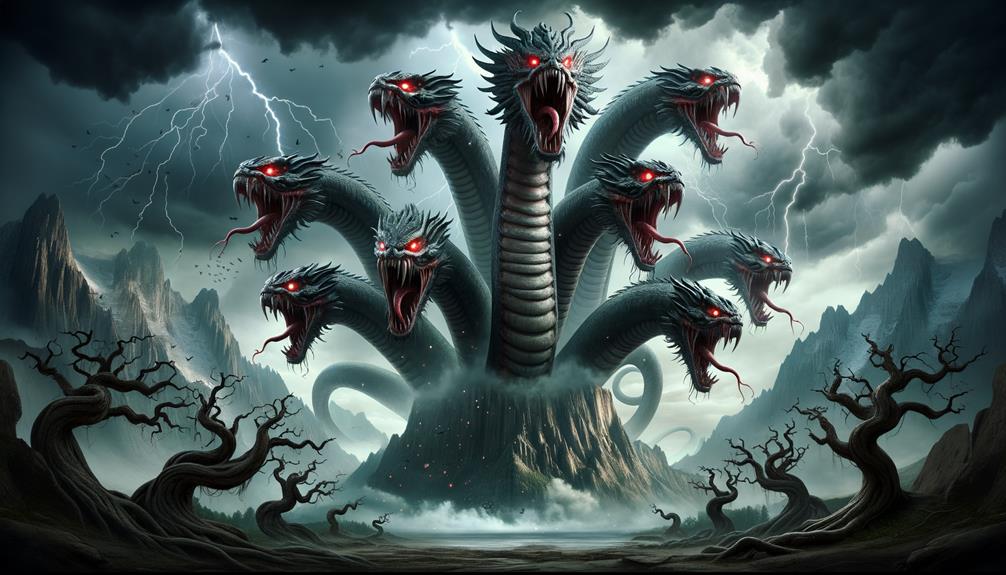
Yamata no Orochi is the immense eight-headed, eight-tailed serpent defeated by Susanoo in early Japanese myth. The Kojiki and Nihon Shoki agree on the core encounter—an Izumo family, a daughter in danger, strong liquor, and a sword found in the serpent’s tail—but preserve differences that disappear from many modern retellings.
Susanoo arrives in Izumo
After his expulsion from the heavenly realm, Susanoo descends near the upper reaches of the Hi River in Izumo. He finds an elderly couple, Ashinazuchi and Tenazuchi, weeping with their daughter Kushinada-hime. They explain that a many-bodied serpent has devoured one daughter each year. Kushinada-hime is the eighth and last.
What the serpent looks like
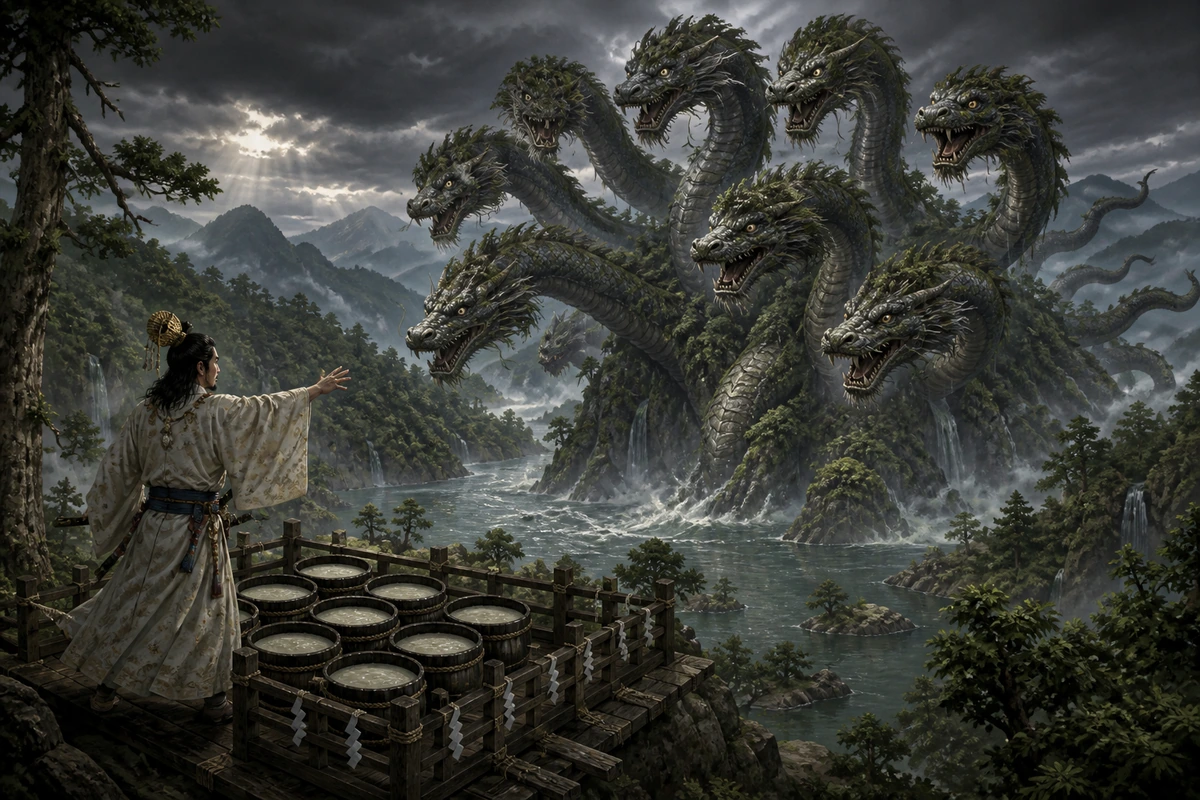
In the Kojiki, Orochi has eight heads and eight tails, eyes like red winter cherries, and a body stretching across eight valleys and eight peaks. Moss, cypress, and cedar grow on its back; its underside is streaked with blood. The repeated eight can signal both a specific count and vast multiplicity in early Japanese expression.
Kushinada-hime becomes a comb
Susanoo agrees to defeat the serpent and asks to marry Kushinada-hime. In the Kojiki, he transforms her into a many-toothed comb and places it in his hair. This protects her and keeps her symbolically present during the fight. Versions that leave her waiting helplessly beside the vats omit this striking transformation.
The eightfold liquor trap
Susanoo orders the family to brew repeatedly refined strong liquor. They build a fence with eight openings, platforms at each opening, and a vessel on each platform. Orochi places a head into every vessel, drinks, and falls asleep intoxicated. Susanoo then cuts the serpent apart with his sword.
The sword inside the tail
When Susanoo cuts a middle tail, his blade is damaged by something hard. Inside he finds a great sword, which he considers extraordinary and presents to Amaterasu. The weapon is called Kusanagi no Tsurugi in the later imperial tradition and becomes one of the Three Sacred Treasures. The Kojiki first calls it Ame no Murakumo no Tsurugi, the “Heavenly Sword of Gathering Clouds.”
Marriage and the palace at Suga
After the victory, Susanoo marries Kushinada-hime and seeks a place to build a palace. At Suga he composes a poem about the many-layered fence of clouds rising around the new household. The verse is traditionally celebrated as an early Japanese poem. The story thus moves from dangerous excess—eight devoured daughters and a sprawling serpent—to an ordered home and genealogy.
Differences in the Nihon Shoki
The Nihon Shoki includes a main account and variant traditions. Names, the landing place, the handling of Kushinada-hime, and the sword’s title can differ. One variant has Susanoo descend in Silla before reaching Izumo. These versions are evidence of multiple mythic and regional traditions, not mistakes to be merged into one seamless biography.
Landscape, flood, and iron theories
Scholars and local interpreters have read Orochi as a river in flood, a network of valleys, hostile groups, or ironworking associated with Izumo. The blood-red belly, river setting, vegetation, and sword make such readings attractive. None is explicitly stated by the early chronicles, so they should be presented as interpretations rather than the myth’s decoded “true meaning.”
Orochi in art and popular culture
Picture scrolls, shrine traditions, theatre, film, manga, games, and anime continually redesign the serpent. Some give it dragon heads; others depict eight separate snakes or add powers absent from the texts. Modern versions show the myth’s vitality, but they should not be used as evidence for what the Kojiki says.
Sources and further reading
- Kokugakuin University, “Yamata-no-Orochi—The Eight-headed, Eight-tailed Serpent”
- Kokugakuin University Digital Museum, Yamata no Orochi
- Kokugakuin University, English and Japanese editions of the Kojiki
- Nihon Shoki, trans. W. G. Aston, account and variants concerning Susanoo in Izumo