
Coatlicue—whose name is commonly translated as “Serpent Skirt”—is one of the most imposing divine figures associated with the Mexica world. She is connected with earth, fertility, death, and divine motherhood, but those overlapping roles should not be reduced to a single modern label such as “Mother Nature.” Much of what can be said securely comes from colonial-era Nahua accounts, monumental sculpture, and the ritual landscape of Tenochtitlan.
Who was Coatlicue?
Coatlicue belongs to a wider group of earth and mother deities in central Mexican religion. Sources do not always describe these figures as neatly separated personalities, and names such as Coatlicue, Toci, and Cihuacoatl can overlap in complex ways. It is therefore safer to describe Coatlicue through the stories and images specifically attached to her than to force her into a fixed family tree.
Her best-known myth makes her the mother of Huitzilopochtli. While sweeping at Coatepec, “Serpent Mountain,” she placed a ball of feathers against her body and became pregnant. Her daughter Coyolxauhqui and the Centzon Huitznahua regarded the pregnancy as a disgrace and prepared to kill her. Huitzilopochtli then emerged fully armed and defeated the attackers. The story survives in a sixteenth-century account recorded by Bernardino de Sahagún and was materially evoked at the Templo Mayor.
The Coatlicue sculpture
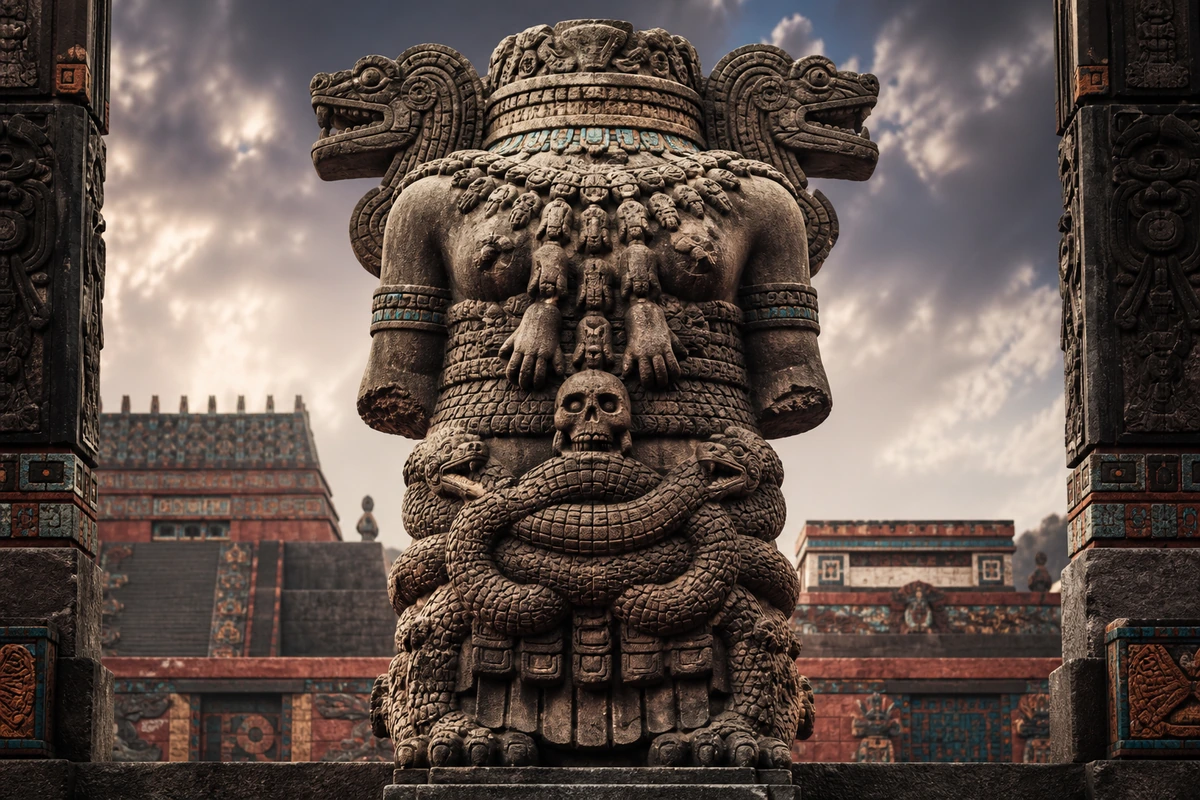
The famous monumental Coatlicue was unearthed in Mexico City’s main plaza in 1790. Today it is one of the defining works in the Mexica gallery of Mexico’s National Museum of Anthropology. Its visual language is deliberately formidable: a skirt of intertwined serpents, clawed feet, a necklace incorporating hands and hearts, and a skull pendant. Two serpent heads meet above the neck, forming a single frontal face.
These are not random emblems or a coded checklist with one settled meaning per object. Together they place the figure within a Mexica visual system in which earth could nourish crops, receive the dead, and demand reciprocal offerings. The sculpture presents creation and destruction as connected powers rather than moral opposites.
Coatepec and the Templo Mayor
The birth of Huitzilopochtli was not simply a story told apart from ritual space. The southern half of the Templo Mayor, dedicated to Huitzilopochtli, recreated Coatepec. The great circular relief of the defeated Coyolxauhqui lay near the foot of that stairway, so a person ascending the temple encountered the myth in architectural form. Coatlicue herself was the threatened mother at the center of that sacred drama.
Coyolxauhqui is often identified with the moon and the Centzon Huitznahua with the stars. That cosmic reading is influential and appears in museum interpretation, but it should not erase the political and ritual dimensions of the myth. At the imperial capital, the narrative also connected Huitzilopochtli’s victory with Mexica identity, warfare, and the ceremonial movement of bodies through the temple precinct.
Why Coatlicue still matters
Coatlicue is important because she resists easy categories. She is maternal without being gentle, terrestrial without being merely agricultural, and terrifying without functioning as an embodiment of “evil.” The sculpture’s survival, rediscovery, and later place in Mexico’s national museum have also made it central to modern conversations about Indigenous heritage and the interpretation of pre-Hispanic art.