Accuracy note: Skanda, Kārttikeya, Kumāra, Subrahmaṇya, and Murugan are overlapping names and traditions for a major South Asian deity. His birth, mothers, battles, consorts, appearance, and relationship to regional landscapes differ across Sanskrit and Tamil sources.
Skanda is often introduced as “the Hindu god of war,” but that label is only a beginning. In Sanskrit epic and Purāṇic stories he becomes commander of the gods and defeats Tāraka. In Tamil traditions Murugan is deeply connected with hills, youth, beauty, the vēl spear, poetry, pilgrimage, and relationships with Valli and Devasena. Living worship cannot be reduced to a catalog of demon battles.
Why does Skanda have many names?
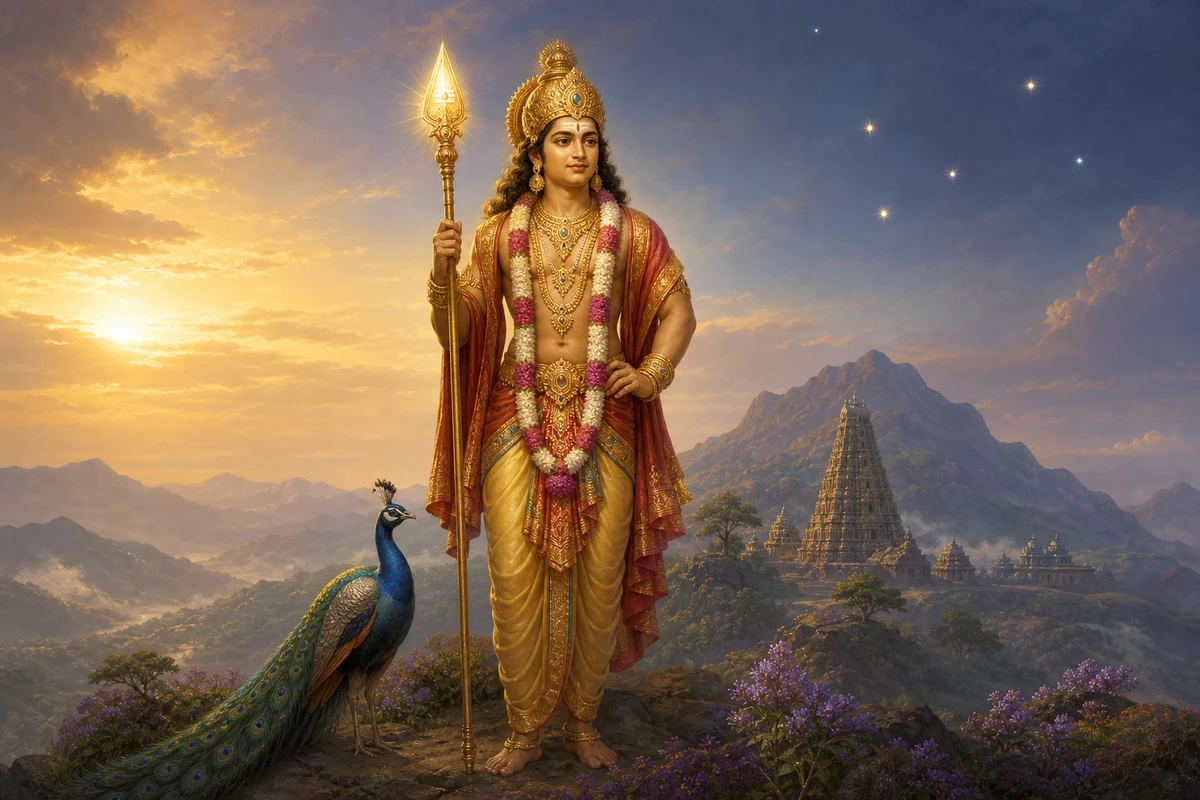
Skanda is an early and widespread Sanskrit name. Kumāra means youth or prince. Kārttikeya connects him with the Kṛttikās, commonly the six stars of the Pleiades who nurture him in many birth accounts. Ṣaṇmukha, “six-faced,” and Tamil Āṟumukam express a form with six heads. Subrahmaṇya is prominent in temple traditions, while Murugan is foundational in Tamil religious culture.
These are not merely interchangeable nicknames from one original story. Each name can carry a history of texts, languages, iconography, theology, and local practice.
Birth stories: fire, river, reeds, and six mothers
A recurring problem drives many Sanskrit versions: the asura Tāraka has gained protection that makes a son of Śiva the necessary opponent. Yet Śiva’s generative energy is too intense for an ordinary birth. Agni, the fire god, carries it; Gaṅgā or another container receives it; and the child emerges in a reed bed, the śara-vana.
The six Kṛttikās nurse the child. In later explanations, he manifests six faces so that he can drink from all six mothers at once. Other accounts assign greater roles to Pārvatī, Svāhā, Agni, or Gaṅgā. The Mahābhārata itself preserves more than one sequence. A single diagram of “father, mother, birthplace” therefore gives false precision.
Commander of the gods and Tāraka
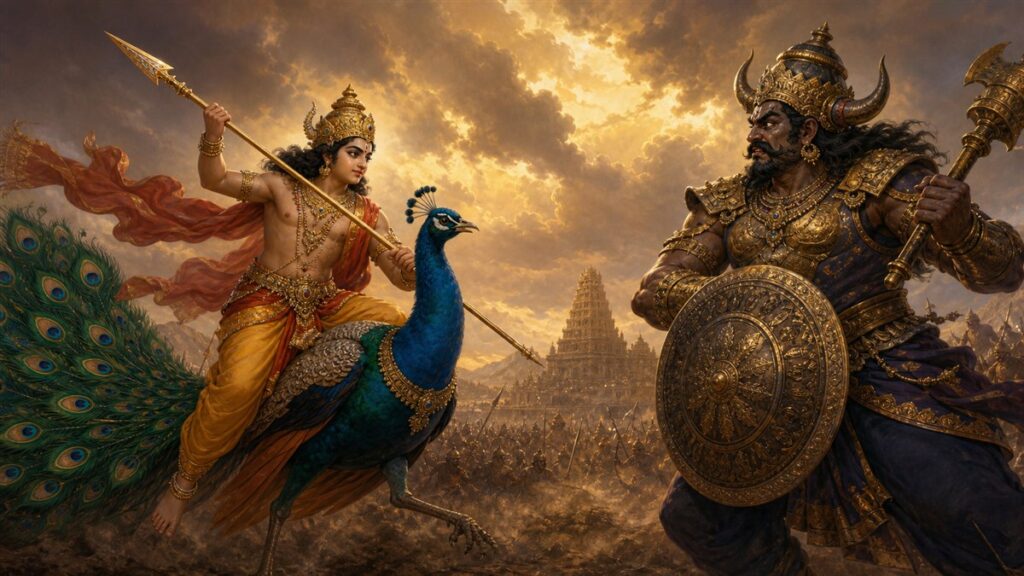
The gods recognize the extraordinary child as their commander, deva-senāpati. He grows or assumes military authority at supernatural speed and confronts Tāraka. The battle fulfills the condition tied to the asura’s protection and restores divine power.
Later texts greatly expand Skanda’s campaigns. Tamil Kanta Purāṇam and festival traditions emphasize Sūrapadman, whose defeat is commemorated during Skanda Ṣaṣṭi. In a popular ending, parts or forms of the defeated opponent become the peacock mount and rooster emblem. Tāraka and Sūrapadman should not be collapsed into one generic “demon king.”
The vēl, peacock, and six faces
| Feature | Meaning and variation |
|---|---|
| Vēl spear | Divine weapon strongly associated with Murugan; in Tamil tradition it may be given by his mother |
| Peacock | Mount and royal bird; its origin is explained differently across texts and images |
| Rooster emblem | Banner or symbol prominent in southern iconography |
| Six faces | Links six mothers, directions, powers, or modes of perception in later interpretation |
| One face | Also ancient and legitimate, especially in particular sculptures and temple forms |
An early north Indian terracotta figure at the Metropolitan Museum is identified by a harpoon-like spear, demonstrating that the weapon-bearing youth has a long visual history. Southern bronzes and temple icons may show a very different posture, number of arms, and family group.
Murugan in Tamil tradition
Early Tamil poetry associates Murugan with the kuṟiñci, the mountainous landscape of lovers, hunters, and difficult travel. He is called Cēyōṉ, the Red One, and appears through possession, ritual specialists, and the spear. These materials do not simply reproduce a Sanskrit Tāraka narrative in translation.
Over centuries, Murugan traditions interact with Sanskrit Skanda-Kārttikeya narratives while retaining distinctive places and relationships. The six major abodes in Tamil Nadu structure pilgrimage. Valli, linked with hill communities and a courtship cycle, and Devasena, associated with the gods’ celestial order, are both important consorts in many southern traditions.
Skanda in northern and southern practice
Kārttikeya remains significant across India and beyond, but the intensity and public profile of worship varies by region. He is not a “forgotten northern god” replaced everywhere by another deity, nor is Murugan solely a local survival untouched by pan-Indian exchange. Archaeology, inscriptions, coins, Sanskrit texts, Tamil poetry, and temple practice show centuries of movement in both directions.
How to describe his battles accurately
Use the adversary and source, not the vague phrase “demonic forces.” Tāraka belongs to the birth-and-command cycle found in epic and Purāṇic literature. Sūrapadman is central to a different, especially Tamil, devotional and festival complex. The battles express divine protection and restoration, but devotees also encounter Skanda as teacher, child, brother of Gaṇeśa, patron of language, and intimate lord of particular hills.
Sources and museum context
- Skanda Purāṇa selection on Kārttikeya’s birth: one Purāṇic version with cross-references
- Comparative note on Skanda’s birth traditions: epic and Purāṇic stages
- Metropolitan Museum of Art: early Kārttikeya-Skanda terracotta