
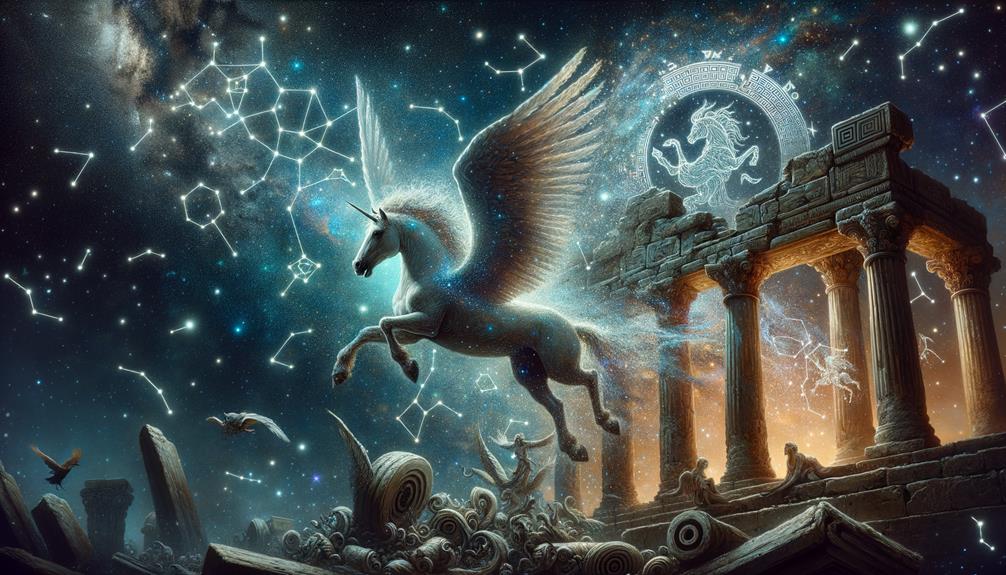
Pegasus is the winged horse of Greek mythology, best known through stories about Medusa, Bellerophon, the Chimera, and the gods of Olympus. Modern retellings often combine details from authors who wrote centuries apart. The main episodes are ancient, but their order and emphasis vary among the sources.
The birth of Pegasus
Hesiod’s Theogony says that Pegasus and Chrysaor sprang from Medusa when Perseus cut off her head. Their father was Poseidon. Pegasus then flew away from the earth and came to the gods, where he carried thunder and lightning for Zeus.
Later authors and artists expanded the scene. Some show the horse emerging directly from Medusa’s neck, while others connect the birth with blood falling onto the ground. Pegasus and Chrysaor are brothers in this genealogy, even though one is a winged horse and the other is usually represented as human.
Bellerophon and the golden bridle
Pegasus is also the mount of Bellerophon. In Pindar’s Olympian Ode 13, Bellerophon struggles to catch the horse near the spring of Peirene at Corinth. Athena appears in a dream and gives him a golden bridle. After he follows the instructions of the seer Polyidus and honors Poseidon, Bellerophon is able to bridle Pegasus.
Mounted on the winged horse, Bellerophon defeats the fire-breathing Chimera. He can attack from the air rather than face the creature at close range. Pindar also connects the pair with victories over the Solymi and the Amazons.
The fall of Bellerophon
The hero’s later fate is less uniform. A common later version says that Bellerophon tried to ride Pegasus to Olympus. The attempt failed, and Bellerophon fell back to earth. Some retellings add that Zeus sent a gadfly to sting the horse, but that detail should be attributed to later tradition rather than treated as part of every ancient account.
Pindar says only that Pegasus found shelter in the ancient stables of Zeus and passes over Bellerophon’s death. Homer’s Iliad describes Bellerophon wandering alone and hated by the gods, but Homer does not mention a flight to Olympus. The combined modern story draws on several sources.
Pegasus and springs
Greek and Roman traditions link Pegasus with water. The spring Hippocrene on Mount Helicon was said to have appeared when Pegasus struck the ground with a hoof. Because Helicon was sacred to the Muses, later art and literature joined Pegasus to poetry and inspiration.
The name Pegasus has sometimes been derived from the Greek word pege, meaning spring, but the etymology is disputed. A proposed connection with an Anatolian divine name has also been discussed. The horse’s association with springs is ancient, yet it does not settle the linguistic question.
From Olympus to the stars
Later astronomical tradition placed Pegasus among the constellations. The star figure does not look like a complete horse: maps usually show a forepart, head, wings, and front legs. The constellation’s history belongs to ancient sky lore and should be kept separate from claims that every detail of Bellerophon’s story was written into the stars.
Pegasus has since become a broad emblem of speed, ascent, and poetic imagination. Those meanings developed through later reception. In the earliest Greek sources, his concrete roles are more specific: child of Medusa and Poseidon, companion of Bellerophon, killer of the Chimera with his rider, and servant in the realm of Zeus.
Sources
- Ancient source excerpts concerning Pegasus
- Pindar, Olympian Ode 13, Perseus Digital Library
- Hesiod, Theogony
- J. Paul Getty Museum, Bellerophon, Pegasus, and the Chimera