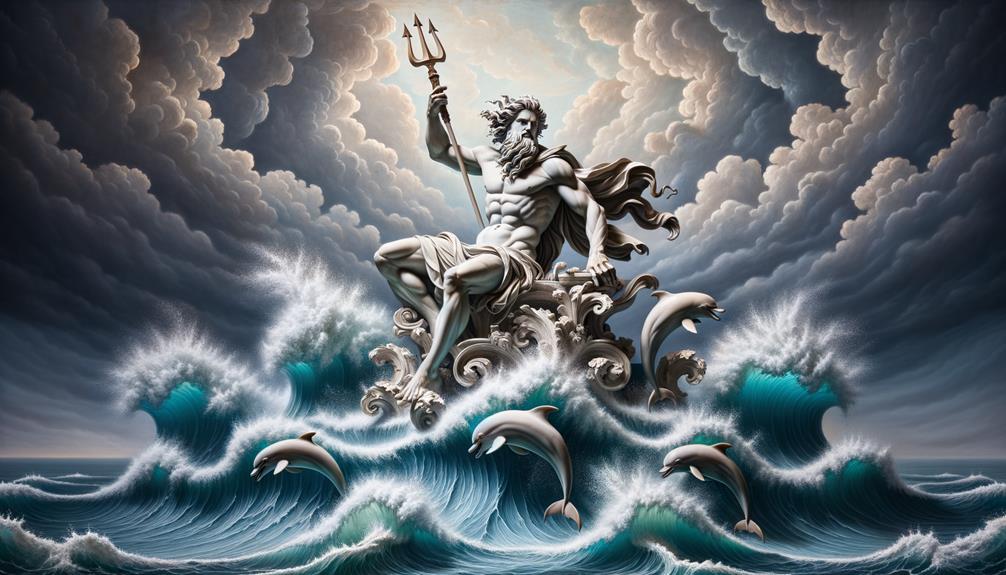
Poseidon is the ancient Greek god of the sea, earthquakes, horses, and powerful natural forces. He is a brother of Zeus and Hades in the dominant literary genealogy, and his worship was spread across the Greek world.
Poseidon in the surviving tradition
Homer calls Poseidon the earth-shaker. In the Iliad he supports the Greeks at points despite Zeus’s commands, while the Odyssey makes his anger at Odysseus a major obstacle to the hero’s return. Odysseus blinds Polyphemus, Poseidon’s son, and the god answers the Cyclops’s prayer by prolonging the voyage. The episode is a conflict within an epic, not a simple case of hero against villain.
Texts, objects, and evidence
Poseidon’s trident identifies him in art, and horses are closely associated with him. Sanctuaries stood at coastal and politically important sites, including Sounion and Isthmia. The Panhellenic Isthmian Games were held in his honor. Local cult titles could stress the sea, earthquakes, horses, or civic protection, so worship was wider than one standard image.
Key points
- Family: Hesiod names him among the children of Cronus and Rhea. The brothers divide authority after the Titans’ defeat.
- Athens: Athenian tradition tells of a contest between Poseidon and Athena for patronage. Versions differ in details and interpretation.
- Troy: Poseidon is linked with the building of Troy’s walls and later hostility toward the city in some accounts.
- Moral labels: Greek gods act according to honor, obligation, cult, and narrative conflict. Modern labels such as hero or villain flatten the texts.
How to read the material
Claims about a single weakness, personality type, or set of universal powers usually come from modern entertainment. Ancient evidence is distributed across epic, hymns, local cult, inscriptions, and art.