
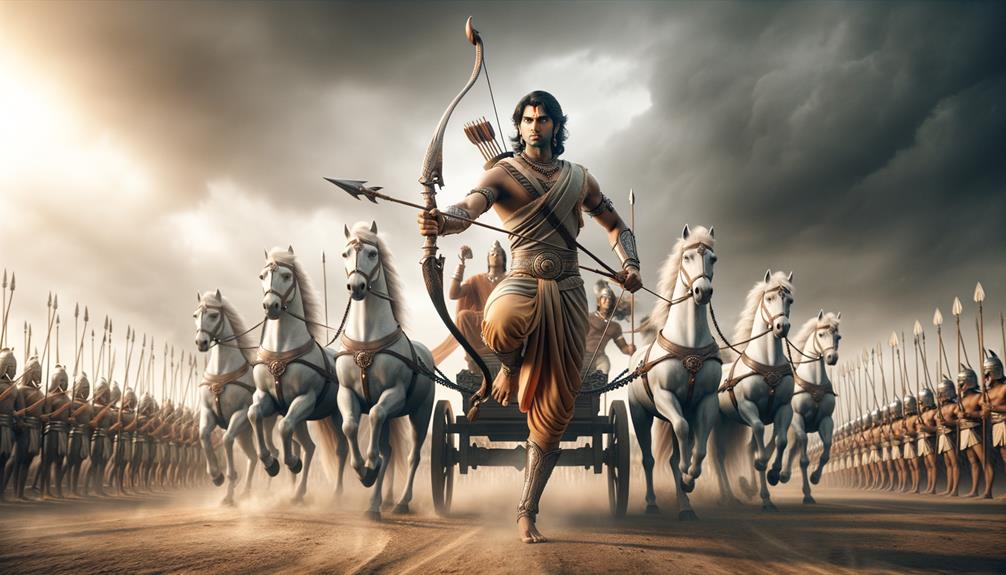
Arjuna is a leading warrior of the Mahabharata and the listener addressed by Krishna in the Bhagavad Gita. He belongs to the five Pandava brothers and is famed for archery, discipline, uncertainty, and a demanding relation to duty.
Arjuna in the surviving tradition
Arjuna is the son of Kunti and the god Indra. He studies under Drona, wins Draupadi at her svayamvara, and shares marriage with his brothers under the epic’s unusual family arrangement. During exile he obtains divine weapons and forms alliances. He also fathers Abhimanyu, whose death in the Kurukshetra war becomes a major grief.
Texts, objects, and evidence
At the opening of the Bhagavad Gita, Arjuna sees teachers and relatives on both sides and refuses to fight. Krishna responds with teachings on action, knowledge, devotion, self, and divine reality. The dialogue does not merely command violence; it places the battlefield crisis inside a larger argument about disciplined action without attachment to results.
Key points
- Bow: Arjuna’s bow is Gandiva, received through Agni in the Khandava Forest episode.
- Krishna: Krishna serves as charioteer, friend, relative, and divine teacher.
- Ekalavya and Karna: The training stories expose hierarchy, exclusion, rivalry, and the moral cost of heroic institutions.
- Many versions: Sanskrit recensions, regional retellings, performance, and modern adaptations vary in detail.
How to read the material
Arjuna cannot be understood through combat skill alone. Hesitation, dependence, vows, family ties, and ethical conflict are the core of his story.