
Accuracy note: Papa Legba belongs to Haitian Vodou, not Hindu tradition. This post currently sits in a Hindu Mythology URL path; its category should only be corrected when a tested redirect can preserve the existing address.
Papa Legba is a lwa—a spirit served in Haitian Vodou—whose role is closely associated with access, communication, roads, and thresholds. He is commonly addressed at the opening of a ceremony so that communication with the other lwa can proceed. The institutional and scholarly sources below describe this as mediation; they do not present him as a demon bargaining for favors or a universal wish-granting spirit. Vodou is a living religion, and ritual practice is learned within communities rather than from a generic do-it-yourself “invocation.”
Papa Legba’s Place in Haitian Vodou
Vodou recognizes a supreme creator, often called the Gran Mèt, and many lwa with distinct temperaments and fields of activity. The Canadian Museum of History’s Vodou glossary explains that Legba is the first lwa invoked by an oungan or manbo—a priest or priestess—because he clears the path connecting human beings with the Divine and the other lwa. This is a religious office of mediation, not a claim that Legba automatically grants every request.
Materials in the University of Florida–Duke University Vodou Archive describe Atibon Legba as a guardian of entries, roads, and paths. The archive gives Legba priority in a service and explains that he makes communication with God and the other lwa possible. It also records a familiar Haitian portrayal: an elderly figure with a broad hat, cane or crutch, pipe, and woven bag. These details communicate age and authority in particular ritual and artistic contexts; they should not be converted into a checklist of supernatural “signs.” Finding a key, seeing a dog, smelling coffee, or noticing certain colors is not by itself evidence that Papa Legba is present.
Legba, Crossroads, and Different Lwa
Crossroads are important in Vodou because they express meeting, movement, and the passage between domains. Even so, not every crossroads figure is simply another name for Papa Legba. The Canadian Museum of History’s glossary lists Legba and Mèt Kafou separately and assigns them different ritual roles. The Vodou Archive uses titles such as Atibon Legba and Alegba and says that Legba is served in several rites. These sources do not support collapsing every crossroads figure into one interchangeable “crossroads god.”
Likewise, the claim that Papa Legba is “fluent in every language” turns a ritual role into a literal superpower. A more careful description is that he enables communication: the Vodou Archive says that Legba allows humankind to communicate with God and the other lwa. Ritual mediation is not the same as literal fluency in every human language.
West African Roots Are Not Simple Equivalents
Papa Legba as described here belongs specifically to Haitian Vodou, a religion formed in Haiti through the experiences and knowledge of enslaved African peoples and their descendants. Related names and functions occur across the Atlantic, but they exist in their own languages, pantheons, and ritual systems. Duke University’s Sacred Arts collection identifies a Fon Legba from Benin as part of West African Vodun and notes his historical relationship to the Yoruba deity Èṣù. In Yoruba religion, Èṣù—also written Eshu or Eshu Elegba—is an orisha associated with mediation, crossroads, markets, and unpredictability.
Museum objects make the differences visible. Cornell University’s Johnson Museum describes a Yoruba Eshu Elegba staff with cowrie shells, indigo pigment, and a dramatically elongated form. Wake Forest’s Lam Museum explains Eshu’s trickster dimension and his place as messenger among humans, orishas, and ancestors. Those objects and descriptions do not reproduce the elderly Haitian portrayal. Shared themes point to historical relationships across the Atlantic, not to a single figure who remained unchanged.
Legba Traditions Across the African Diaspora
Duke University’s collection describes Eleguá in Cuban Santería/Ocha as a mediating oricha of the crossroads who is honored first. Scholar Ina Fandrich’s study places Cuba’s Lucumí, Brazil’s Candomblé and Umbanda, Haitian Vodou, and New Orleans Voodoo within connected but distinct historical developments. Names such as Eleguá and Exu therefore belong to particular religions and should not be treated as interchangeable labels for Papa Legba. “Vodou” in Haiti and “Voodoo” in New Orleans identify related but different traditions.
Catholic images provide another example of local adaptation. A Smithsonian Folklife account explains that Haitian Vodou incorporated Catholic elements while saint images were appropriated and interpreted within Vodou—a relationship that scholars continue to debate. Such correspondences do not make Papa Legba simply “the Vodou version” of Saint Peter or any other saint; a borrowed image can acquire a new religious meaning in its Vodou setting.
Vèvè, Music, and Respectful Representation
Vodou ceremonies use music, movement, prayer, and visual art. A vèvè is a sacred design associated with a lwa, often drawn on the ground during ritual. Duke University’s Sacred Arts of the Black Atlantic project documents a Haitian Rada drum bearing Papa Legba’s vèvè. The symbol belongs to a ceremonial system; it is not a decorative spell or a guarantee that copying it will produce a spiritual result.
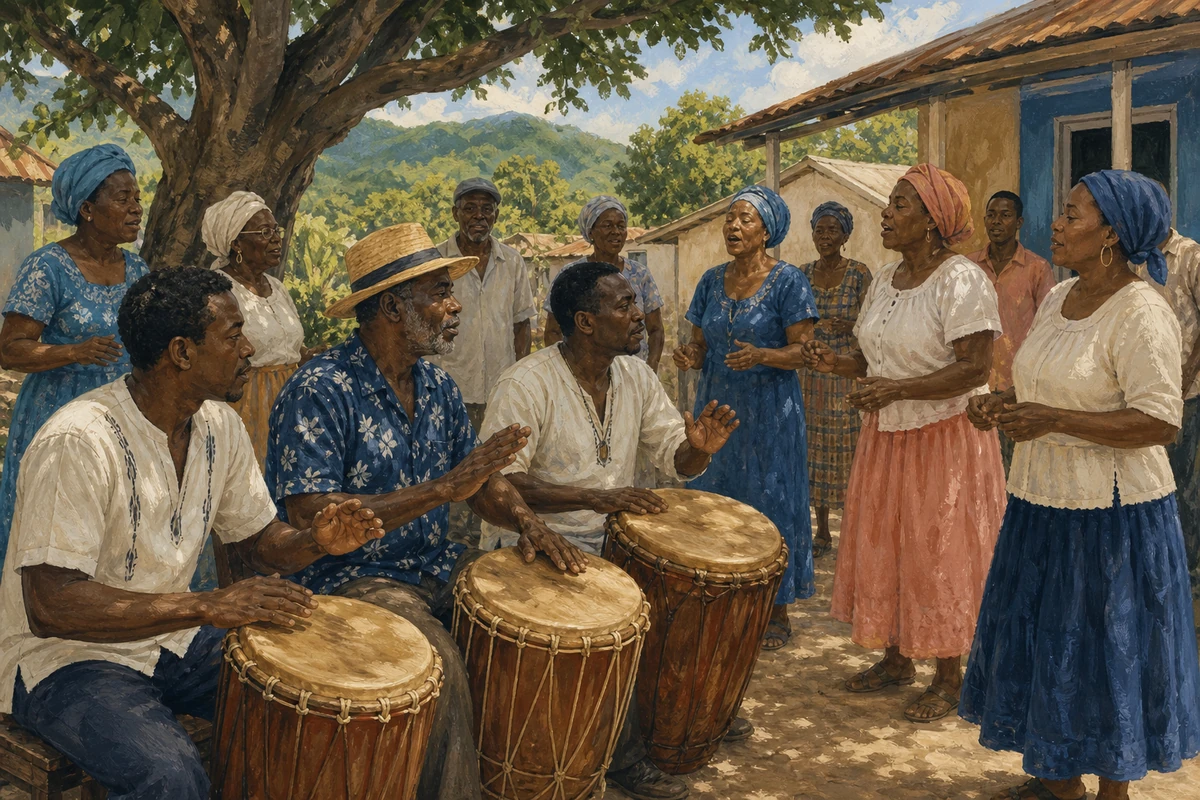
Published sources describe decentralized Vodou and house-based religious life, not a universal ritual recipe. Lists that prescribe candles, rum, coffee, tobacco, food, keys, a midnight hour, or a crossroads as one required method are therefore misleading. Ritual specifics are guided within particular communities. A responsible introduction can explain Papa Legba’s importance without instructing readers to perform a ceremony or claiming that ordinary coincidences reveal his presence.
Sources and Further Reading
- Canadian Museum of History, Vodou Glossary
- University of Florida and Duke University, The Vodou Archive
- Gerdes Fleurant, “Vodou,” Smithsonian Folklife Festival program
- Duke University, “Rada Drum Set”
- Duke University, “Legba Statue”
- Herbert F. Johnson Museum of Art, Cornell University, “Staff Finial (Ogo Elegba)”
- Wake Forest University, “Yoruba Eshu Figure”
- Duke University, “Eleggúa Statue”
- Ina J. Fandrich, “Yorùbá Influences on Haitian Vodou and New Orleans Voodoo”, Journal of Black Studies
- Harvard Pluralism Project Archive, “La Source Ancienne Sosyete”