

Leizu (嫘祖), also called Lei Tsu or Xiling Shi in older romanizations, is remembered as the wife of the Yellow Emperor and the ancestral patron of sericulture—the raising of silkworms and production of silk. A beloved legend credits her with discovering that a cocoon could be unwound into a fine filament. Archaeology, however, shows that silk technology developed over a long period and cannot be reduced to one accidental moment.
The cocoon in hot water
In a widely repeated story, a silkworm cocoon falls into Leizu’s hot drink. The heat softens sericin, the natural gum holding the cocoon together, and she draws out a long strand. She then studies the silkworm’s life cycle and teaches others to cultivate mulberry trees, raise the insects, reel their filaments, and weave cloth.
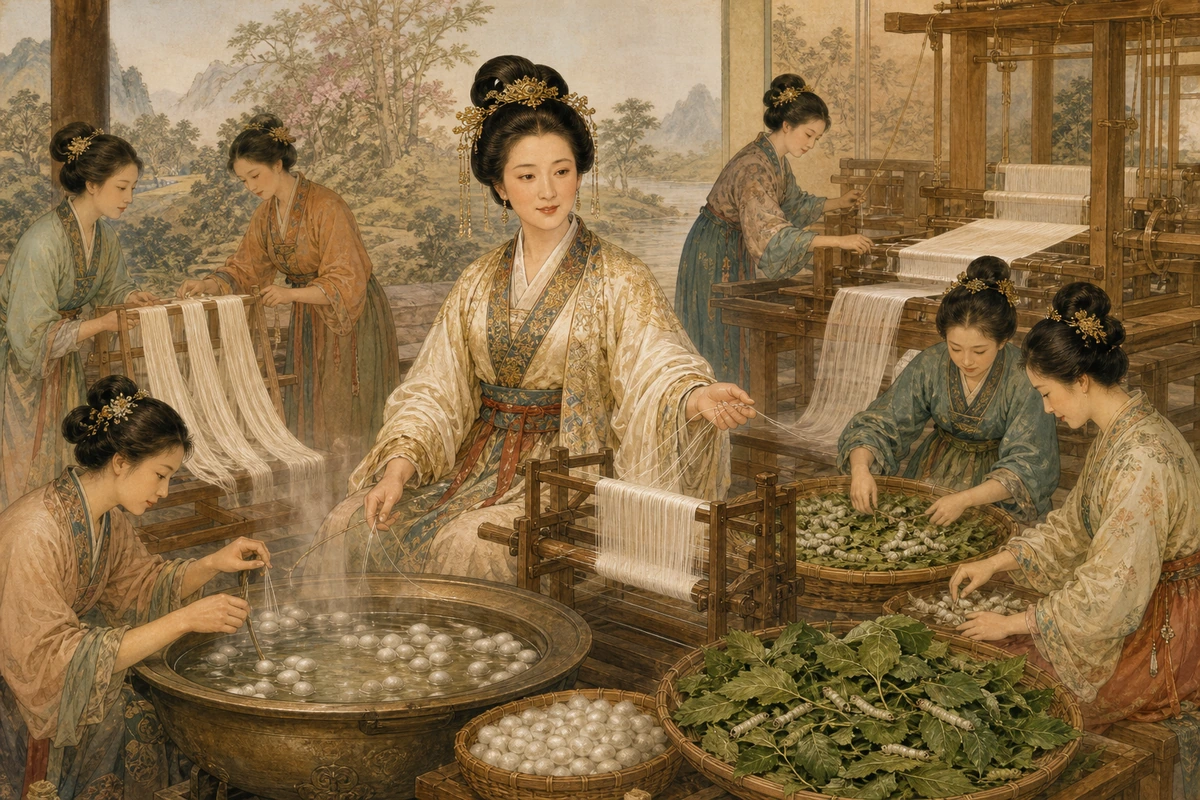
The hot-drink episode is an origin legend, not a contemporary eyewitness report. Its strength is explanatory: one visible filament becomes a way to imagine how hidden material inside a cocoon could be recognized and transformed.
Sericulture is a system, not a single trick
Traditional silk production requires coordinated expertise. Mulberry trees must be maintained; silkworm eggs and larvae need controlled conditions and fresh leaves; cocoons are sorted and softened; several filaments are reeled together; thread is twisted, dyed, and woven. A broken cocoon may provide spun silk but cannot be reeled into one continuous filament in the same way.
This complexity is why Leizu’s fuller title as an ancestral patron matters more than a literal claim of instant invention. She personifies an entire body of skill historically associated with households, specialist workshops, and women’s labor.
What archaeology contributes
Silk fibers and textile traces from Neolithic contexts show that people in China used silk before the periods represented by later imperial chronologies. Individual finds must be interpreted carefully because fragile organic material is difficult to preserve and date. Even so, the evidence supports gradual experimentation rather than a technology arriving fully formed from one named court.
Ritual patron of women’s work
Leizu was honored as the First Silkworm Lady or ancestral goddess of sericulture. Imperial rites linked the empress and court women with ceremonial mulberry gathering and silk production. The symbolism joined textile labor to dynastic order, household virtue, clothing, taxation, and wealth.
Leizu’s story can be read beside Shennong, who represents cultivation and plant knowledge, and Cangjie, who represents writing. Each legend gives a human face to knowledge refined across generations.