
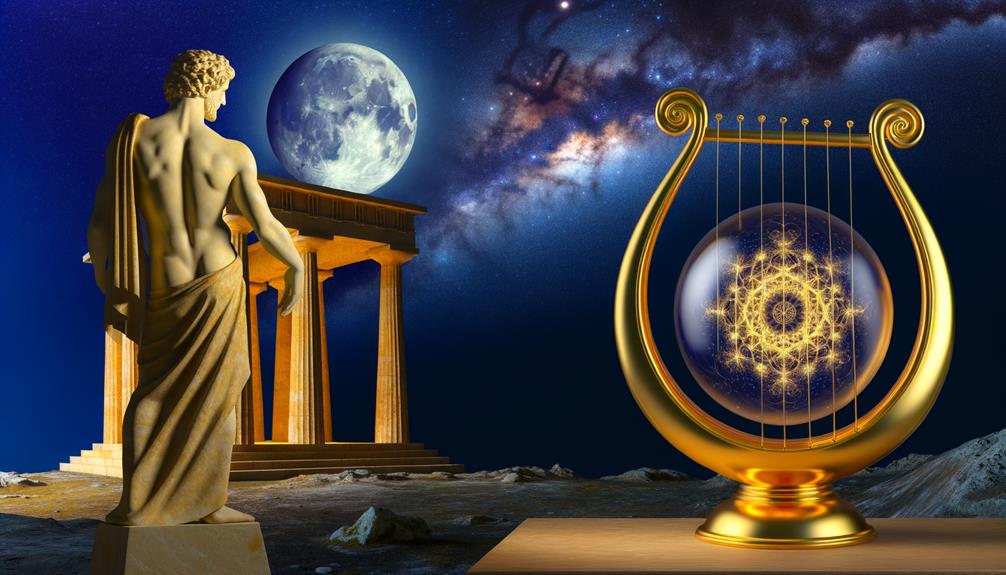
Apollo’s music and prophecy belong together in Greek poetry, but neither can be reduced to a vague idea of perfect harmony. The god plays, leads song, and communicates divine knowledge; people who hear him still have to understand what they receive. The Homeric Hymns and Herodotus provide concrete stories that make those relationships clearer.
These are different kinds of sources. A hymn praises a god through narrative and performance, while Herodotus embeds an oracle in his account of a king’s defeat. Evidence from Delphi and ancient musical instruments adds another perspective without turning either story into a transcript of everyday religious practice.
The lyre, the bow, and the will of Zeus
In the Homeric Hymn to Apollo, lines 123–132, the newborn god declares his attachment to the lyre and the curved bow and his intention to communicate Zeus’s will. Music and prophecy therefore appear together at the very announcement of his divine identity.
Later in the hymn, Apollo reaches Olympus playing his instrument. The Muses sing, and other divine figures dance. Their song contrasts the gods’ enduring privileges with human suffering, old age, and death. This is not simply an image of pleasant entertainment: divine music also expresses the difference between mortal and immortal life.
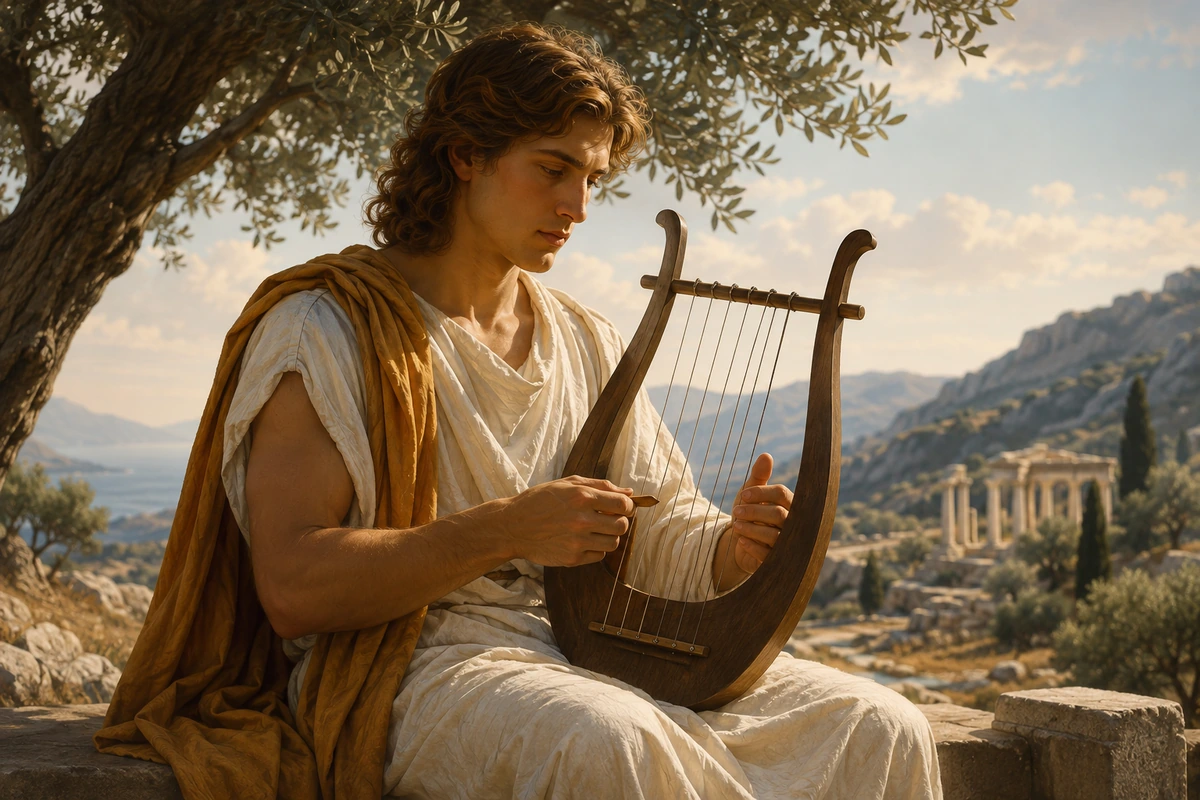
Did Apollo invent the lyre?
The Homeric Hymn to Hermes gives that inventive role to Hermes. Near the beginning, the newly born god makes a musical instrument from a tortoise shell and other materials, fitting it with seven strings. He then steals Apollo’s cattle, setting off a quarrel that eventually reaches Zeus.
When Hermes plays and sings before Apollo, the music changes the encounter. Apollo delights in the sound and wants to learn the art. At lines 463–503, Hermes offers him the lyre, Apollo accepts it, and their dispute gives way to an exchange of gifts and responsibilities.
In this version, Apollo’s close association with the lyre does not require him to be its inventor. The instrument also helps establish a relationship between the brothers. It is a gift and a means of reconciliation, not merely a decorative attribute placed beside the god.
Lyre and kithara are related, not identical
The Metropolitan Museum’s account of the kithara describes it as an instrument within the lyre family, with a substantial wooden body suited to public performance. A player used a plectrum in one hand while the fingers of the other damped selected strings.
The museum distinguishes this large-bodied instrument from the tortoiseshell lyra. Calling every ancient stringed instrument a harp—or assuming that every image of Apollo shows precisely the same construction—loses that distinction. Mythological ownership of an instrument and the history of musical performance are related questions, but they are not interchangeable.
Apollo, the Pythia, and Delphi
At Delphi, Apollo’s prophetic authority was expressed through the Pythia, his priestess. The Greek Ministry of Culture’s site history describes consultation by communities, rulers, and private individuals, with offerings contributing to the sanctuary’s prominence. Delphi was a religious institution in a wider social and political world, not simply an isolated seer in a cave.
The archaeological site’s account of its beginnings distinguishes Apollo’s legendary arrival from material evidence for his cult, traced there to the eighth century BCE. Bronze figurines and tripod cauldrons belong to that evidence; the Pythia’s sacred tripod also had an important place in representations of her prophetic role.
The hymn offers its own foundation narrative. Apollo establishes his sanctuary and brings Cretan men to serve there. Near the poem’s end, he leads them toward Pytho while playing the lyre, and they follow singing a paean. Music and the foundation of an oracular community are joined within the story itself.
Croesus and the oracle he misunderstood
In Herodotus, Histories 1.53–54, Croesus receives an answer that campaigning against the Persians will bring down a great empire. He takes this as encouragement, assuming that the empire will be Cyrus’s. His own kingdom is the one that falls.
When the answer is defended later, at 1.91, the response says Croesus should have asked which empire the god meant. The narrative makes interpretation central: confidence in divine authority does not protect the consultant from a disastrous assumption.
This is a famous story about an ambiguous answer, not proof that all Delphic responses were riddles. Nor is its retelling evidence that an oracle could demonstrably predict the future. What can be examined is how Herodotus presents the answer, the king’s expectation, and the explanation given after his defeat.
More than a general “god of the arts”
These sources give Apollo’s artistic and prophetic roles a sharper outline. He is a musician among the gods, a recipient of Hermes’s inventive gift, a leader of sacred song, and a source of counsel whose human hearers can misunderstand it. The stories become more revealing when their details remain attached to the texts that preserve them.