
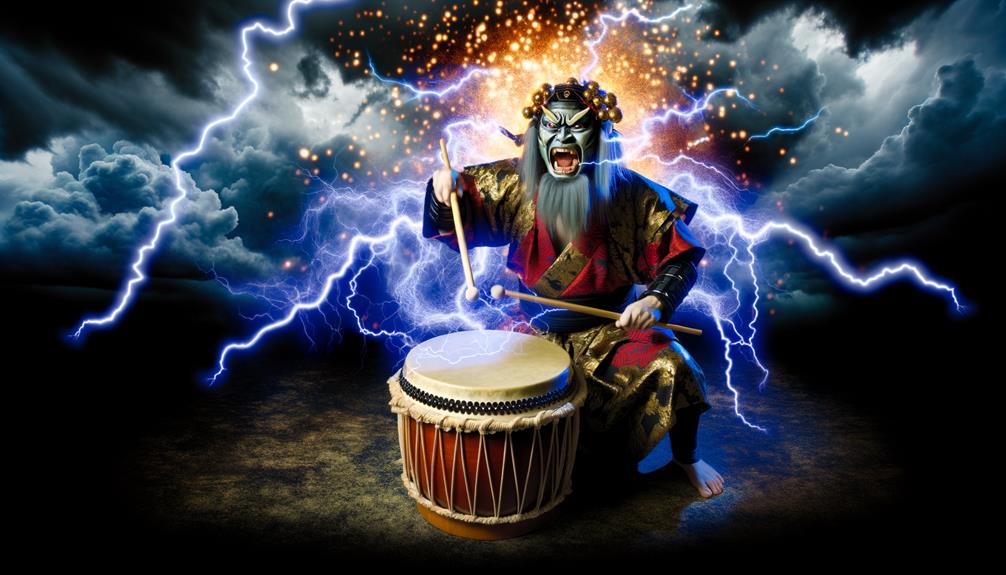
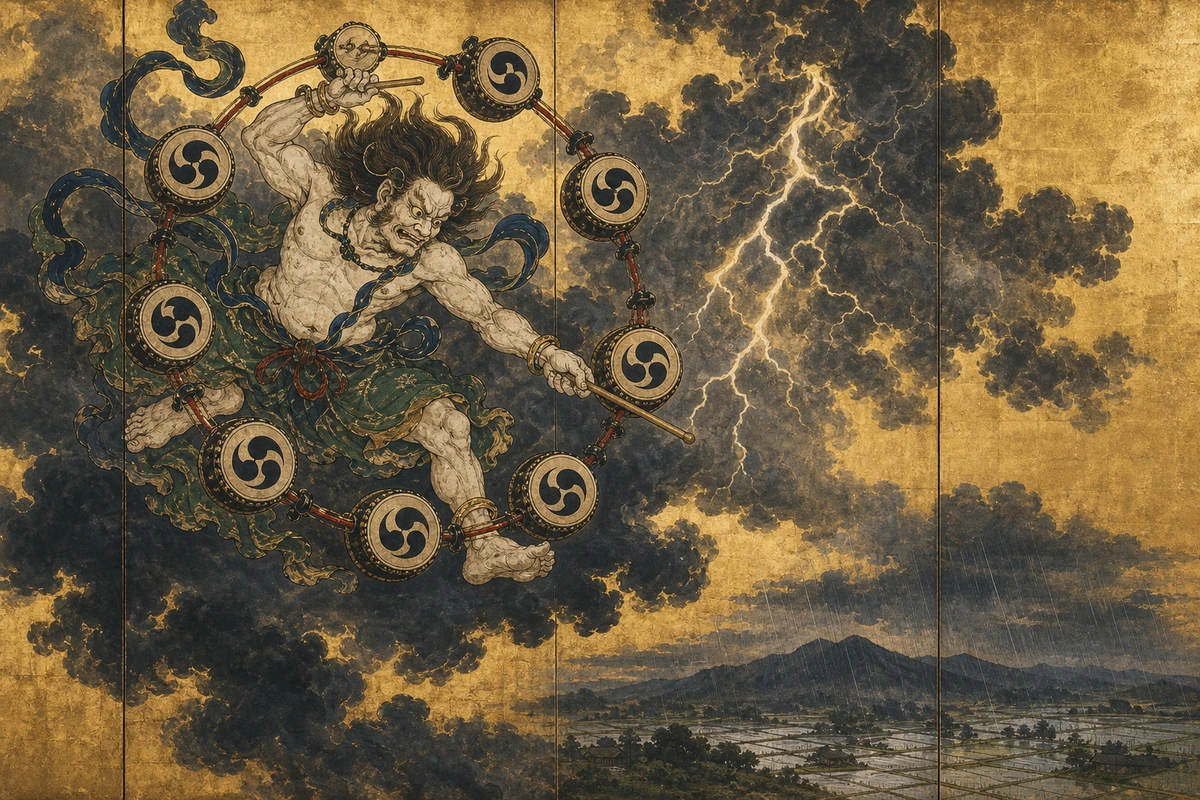
Raijin is the Japanese deity of thunder, instantly recognizable in later art by a ring of drums struck amid storm clouds. That famous image is a historical synthesis rather than a scene lifted unchanged from Japan’s earliest chronicles. Raijin’s tradition joins ancient thunder kami, Buddhist guardian imagery, agricultural dependence on rain, temple sculpture, folding-screen painting, festival culture, and everyday weather lore.
What does the name Raijin mean?
Raijin combines characters meaning “thunder” and “deity” or “spirit.” The same figure or closely related thunder power may be called Raiden, Kaminari-sama (“honorable thunder”), or by more specific names in shrines, texts, and local traditions. These labels overlap without necessarily identifying one perfectly fixed personality.
English descriptions often say “the Japanese god of thunder,” which is a useful introduction. Japan’s religious history, however, does not organize every force under one exclusive divine office. Thunder can be a named figure, a group of thunder beings, an action of another kami, a Buddhist protector, an ancestral power, or a dangerous local presence.
Thunder deities in the Kojiki and Nihon Shoki
Japan’s early eighth-century chronicles contain thunder imagery before the familiar drum-ring Raijin appears in its later form. When the creator deity Izanagi enters Yomi, the land of the dead, he sees Izanami’s decaying body associated with multiple thunder deities. The Kojiki names eight thunder beings located in different parts of her body.
Versions in the Nihon Shoki arrange the underworld encounter differently. The episode links thunder with death, decomposition, fear, and generative cosmic power. It should not be retold as though one modern-looking Raijin simply stands beside Izanami beating drums.
Other early narratives connect thunder with heavenly authority and violent descent. Because “thunder” can translate several names and descriptions, identifying every occurrence as the biography of one individual Raijin creates a false unity.
Why does Raijin beat drums?
In mature iconography, Raijin is a muscular, fierce-faced figure surrounded by drums that he strikes to produce thunder. The drums frequently bear the comma-shaped tomoe or three-part mitsudomoe design, a motif widely used in shrine, martial, and decorative contexts.
The visual explanation is intuitive: drumbeats imitate the rolling and crashing of thunder. Yet the full image developed through artistic exchange. Chinese thunder officials, Buddhist figures, guardian deities, and Japanese representations of kami all contributed to a form that became unmistakably local.
Raijin’s fierce face, wild hair, claws, and dynamic pose can resemble an oni. Appearance does not make him merely an evil demon. Wrathful forms in Buddhist and Japanese religious art may protect sacred space, command dangerous forces, or inspire awe.
Raijin and Fūjin
Raijin is often paired with Fūjin, the wind deity who carries a great bag of winds. Together they visualize the storm: wind drives clouds and rain while thunder breaks across the sky. Their partnership is especially prominent in sculpture and painting, but neither deity is defined only through the other.
At Sanjūsangen-dō in Kyoto, statues of the wind and thunder gods stand within a large Buddhist ensemble centered on Thousand-Armed Kannon. This setting is important. It shows how figures now casually labeled “Shinto gods” could be incorporated into Buddhist sacred art and temple protection.
Separating Shinto and Buddhism into sealed historical boxes misrepresents much of premodern Japan. Deities, bodhisattvas, ritual specialists, shrines, and temples were connected through practices and theories that changed over time.
The Wind God and Thunder God screens
Tawaraya Sōtatsu’s early seventeenth-century folding screens of Fūjin and Raijin are among the most influential images in Japanese art. The two figures occupy broad gold-leaf fields, separated by charged empty space. Raijin’s white body, drums, ink contours, and stormlike movement make the deity feel suspended beyond ordinary ground.
Ogata Kōrin later made a celebrated version engaging Sōtatsu’s composition, and Sakai Hōitsu in turn responded to Kōrin. The sequence is not simple copying. Each artist rebalanced gesture, space, color, and lineage, helping define what is now called the Rinpa tradition.
Because these screens are so famous, modern logos, games, tattoos, mascots, and animation often borrow the circular drums. That visual afterlife is real, but it should not be mistaken for proof that the identical design existed in every period.
Thunder, rain, and rice agriculture
Thunder is frightening because lightning can kill, ignite buildings, split trees, and accompany destructive storms. It is welcome because thunderstorms bring rain during the growing season. For agricultural communities, danger and fertility arrive in the same sky.
Traditional language sometimes links lightning with the fertilization or ripening of rice. Whether interpreted poetically, ritually, or through observed weather, the association explains why a fierce thunder deity can also support abundance. Raijin is not only a monster to be repelled.
Seasonal rites may ask for adequate rain, protection from storms, or relief from drought. Local shrine identities differ, so one region’s practice should not be promoted as a universal national ritual.
Popular stories about navels and thunder
Japanese children may be warned to cover or hide their navels during a thunderstorm because Raijin—or a thunder-associated creature—might take them. Variants say to sleep face-down, hide under bedding, or respond with a protective phrase. The warning gives children a memorable action during frightening weather.
Such sayings belong to folklore rather than a canonical scripture. They may encourage children to cover their bellies when sudden rain cools the air, but practical explanations do not exhaust their humor or imaginative force.
Raijū, a “thunder beast” that descends with lightning in later lore, is sometimes mixed with Raijin. The two can share a storm setting without being the same entity. Raijū descriptions vary from weasel-like or wolf-like animals to more fantastic forms.
Tenjin, Takemikazuchi, and other thunder connections
Several major Japanese deities have thunder associations. Tenjin, the deified scholar Sugawara no Michizane, became linked with disastrous storms and later with scholarship. Takemikazuchi is a powerful martial kami whose name and myths carry lightning or thunder implications. Local thunder shrines may center additional names.
These connections do not turn every thunder deity into an alias of Raijin. Premodern religious traditions often allow powers to overlap, identify, separate, or form temporary correspondences depending on ritual and text.
Raijin across sources and art
| Context | Thunder imagery | What not to assume |
|---|---|---|
| Early chronicles | Multiple thunder deities, Yomi, divine bodies, violent heavenly power | The later drum-ring figure appears unchanged in every scene |
| Buddhist temple art | Wrathful airborne guardian within a sacred ensemble | Fierce appearance means an evil demon |
| Fūjin–Raijin screens | Gold ground, storm motion, drums, paired wind and thunder | One famous painting is the origin of all thunder belief |
| Agricultural and weather lore | Rain, rice growth, lightning danger, protective rites | Raijin is only destructive |
| Modern popular culture | Drum halo, tomoe, lightning, dynamic combat imagery | New character traits are ancient religious doctrine |
Raijin is not “the Japanese Thor”
Comparisons with Thor, Zeus, Indra, or other thunder deities can identify widespread human responses to storms: noise becomes a weapon or instrument, lightning expresses divine force, and rain combines danger with fertility. Comparison is a method, not an equation.
Raijin’s drums, relationship with Fūjin, place in Japanese Buddhist art, chronicle traditions, and rice-growing landscape give him a history no Norse or Vedic figure shares. “Japanese Thor” removes the very details that make the tradition worth studying.
Frequently asked questions
Is Raijin a Shinto god?
He is a Japanese thunder kami, but his familiar imagery also developed inside Buddhist art and a long history of shrine–temple interaction. A simple modern label cannot contain every historical context.
Why are there symbols on Raijin’s drums?
They commonly show tomoe, especially a three-part mitsudomoe. The motif suggests rotation and appears widely beyond Raijin images.
Is Raijin evil?
No. Thunder is dangerous, and Raijin often looks fierce, but he can protect, bring necessary rain, and participate in sacred ensembles.
Are Raijin and Fūjin brothers?
They are a celebrated artistic pair, but “brothers” is not a universal relationship established across early sources. Modern adaptations frequently invent a fixed family structure.