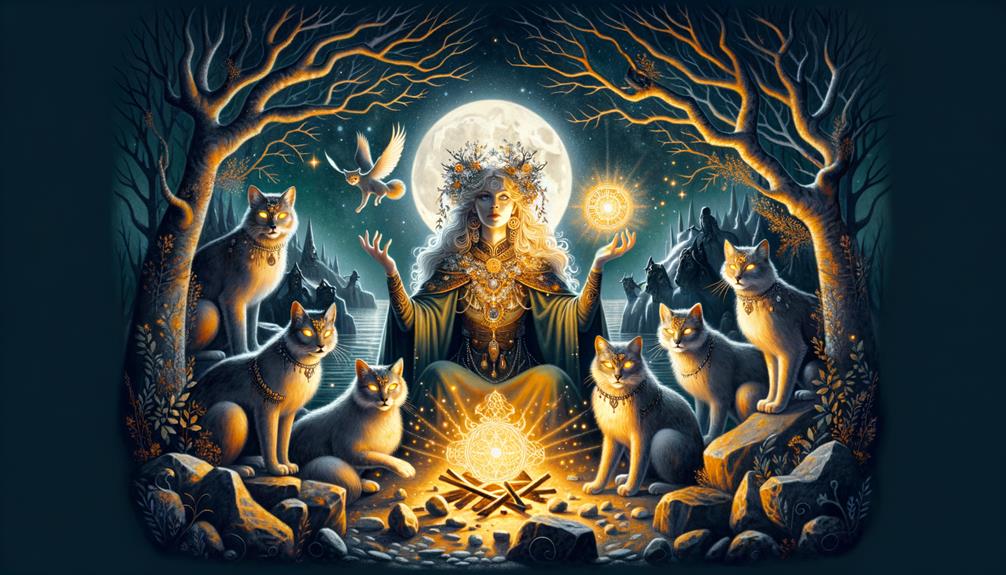
Brísingamen is the celebrated necklace or neck ornament of the Norse goddess Freyja. It is one of mythology’s most recognizable jewels, yet the surviving medieval texts do not provide one stable origin story. Eddic poetry treats it as Freyja’s known possession. A skaldic poem describes Loki stealing it and Heimdall recovering it. The detailed tale in which Freyja acquires the jewel from four dwarfs survives in the much later Sörla þáttr, a Christian and euhemerizing narrative whose attitude toward the old gods is openly hostile.
Source note: The four-dwarf acquisition episode is important, but it should not be presented as though it were told in the Poetic Edda. Source date and literary purpose change how the story should be read.
The necklace in Eddic poetry
In Þrymskviða, Thor’s hammer has been stolen and the giant Þrymr demands Freyja as its price. When the gods disguise Thor as the bride, they dress him in women’s clothing and place Brísingamen on him. The humor depends on the audience already recognizing the necklace as distinctly Freyja’s. The poem does not explain who made it or how she received it.
Lokasenna also assumes the ornament is familiar. During Loki’s exchange of insults with the gods, references to Freyja’s sexuality and divine relationships belong to a ritualized contest of accusation, not a neutral biography. The poem’s taunts should therefore be cited as speech by a hostile character rather than accepted as a transparent factual report about the goddess.
Loki and Heimdall in Húsdrápa
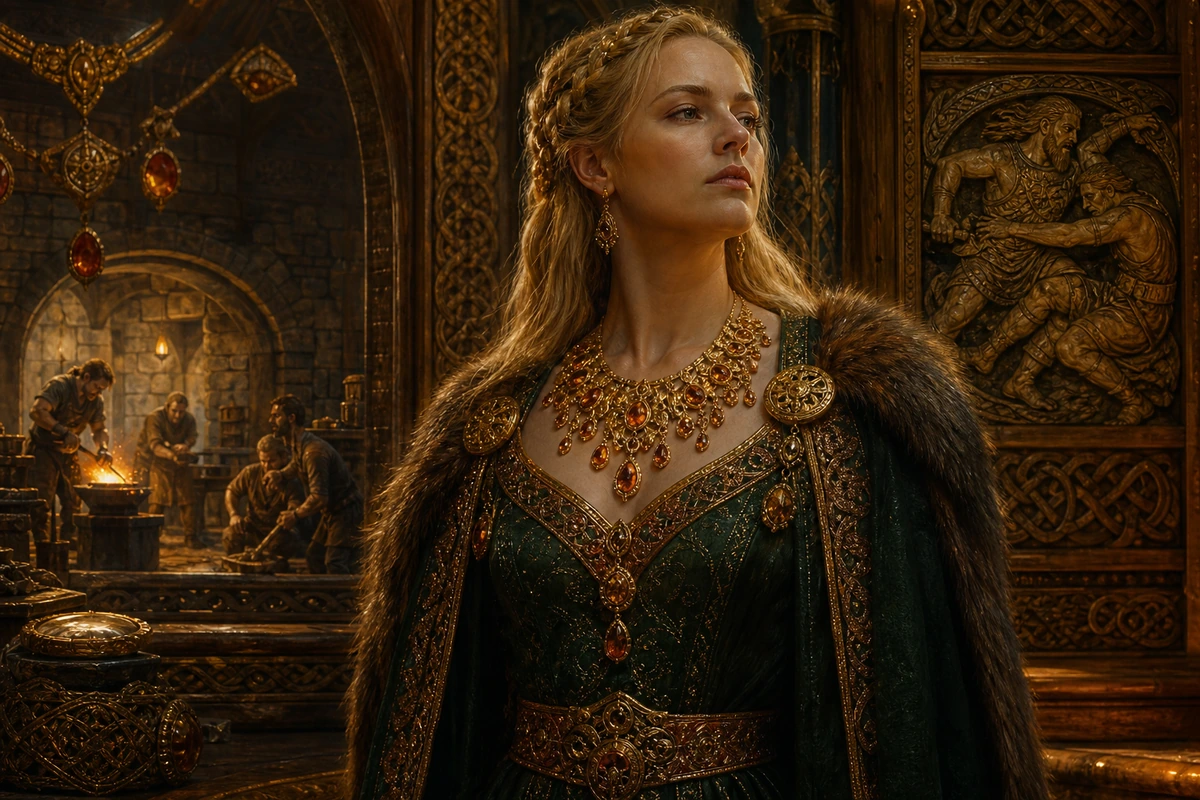
The tenth-century skaldic poem Húsdrápa, preserved in quotations by Snorri, describes scenes carved or painted inside an Icelandic hall. One scene concerns Heimdall and Loki fighting over a precious object identified by Snorri as Brísingamen. The two take seal form and struggle in the sea near Singasteinn, and Heimdall recovers the ornament.
This is evidence for a theft-and-recovery story older than the manuscripts that preserve Snorri’s prose. However, the surviving verses are compressed and difficult; much of the connected plot comes from Snorri’s explanation. It is reasonable to say that Loki steals or contests the necklace and Heimdall wins it back, but not every vivid detail in modern retellings is present in the extant lines.
The four dwarfs in Sörla þáttr
The fullest acquisition story appears in Sörla þáttr, “The Tale of Sörli,” preserved in the late medieval manuscript Flateyjarbók. It presents Odin as a human king in Asia and Freyja as his concubine. Four craftsmen—Álfrigg, Dvalinn, Berlingr, and Grérr—make a magnificent necklace. Freyja offers gold and silver, but they demand that she spend a night with each of them. She agrees and receives the jewel.
Odin then orders Loki to steal it. Loki enters Freyja’s chamber, changes form to overcome the locked space, removes the necklace, and delivers it to Odin. Freyja must accept Odin’s condition that she provoke an endless battle before the ornament is returned. The larger tale eventually places the pagan conflict within a Christian salvation history.
That framing is essential. Sörla þáttr is not simply an untouched pagan myth written down late. It reduces gods to flawed ancient people and uses their behavior to contrast the pagan past with Christian kingship. Its sexual bargain may preserve older motifs, reshape them polemically, or do both. A responsible account reports the story and its context without using it as the sole key to Freyja’s identity.
| Source | Approximate form | Role of Brísingamen | Caution |
|---|---|---|---|
| Þrymskviða | Eddic poem in a medieval manuscript | Recognizable marker of Freyja placed on disguised Thor | No acquisition story is given |
| Húsdrápa | Tenth-century skaldic verses quoted later | Object contested by Loki and Heimdall | The poem survives only in fragments and quotations |
| Snorri’s Edda | Thirteenth-century mythographic handbook | Names Freyja’s necklace and explains allusions | Snorri systematizes earlier poetic material |
| Sörla þáttr | Late medieval legendary tale | Four dwarfs, sexual price, Loki’s theft, Odin’s condition | Christianized and euhemerizing frame |
What does the name mean?
The second element, men, means a neck ornament or necklace. The first element is harder. It has been connected with the Brísingar, with fire or brightness, and with names of dwarfs, but no interpretation commands universal agreement. Translations such as “flaming necklace” are evocative rather than certain etymologies.
The uncertainty is worth preserving. The ornament’s fame does not depend on solving its name. In the sources, its value comes from association: it identifies Freyja, attracts theft, figures in conflict with Loki, and is important enough to be recognized without explanation.
Freyja beyond the necklace
Freyja is connected with desire, wealth, fertility, seiðr, battle-dead, and aristocratic display across Old Norse literature. Brísingamen participates in that rich network but does not reduce her to vanity or sexuality. Jewelry in medieval northern Europe could signal status, alliance, portable wealth, craftsmanship, inheritance, and sacred power. A divine necklace can carry several of those meanings at once.
Modern retellings often want one definitive “price of Brísingamen” story. The medieval record offers something more useful: a famous object moving through different genres. Comedy makes it a costume marker, skaldic art makes it the prize in a supernatural struggle, mythography names it, and a late saga turns its acquisition into a moralized episode. Brísingamen’s history is the history of those retellings.
Sources and further reading
- Sörla þáttr, Nora Kershaw translation with Old Norse text
- Viking Society for Northern Research, Snorri Sturluson’s Edda
- The theft of Thor’s hammer on Mythology Vault