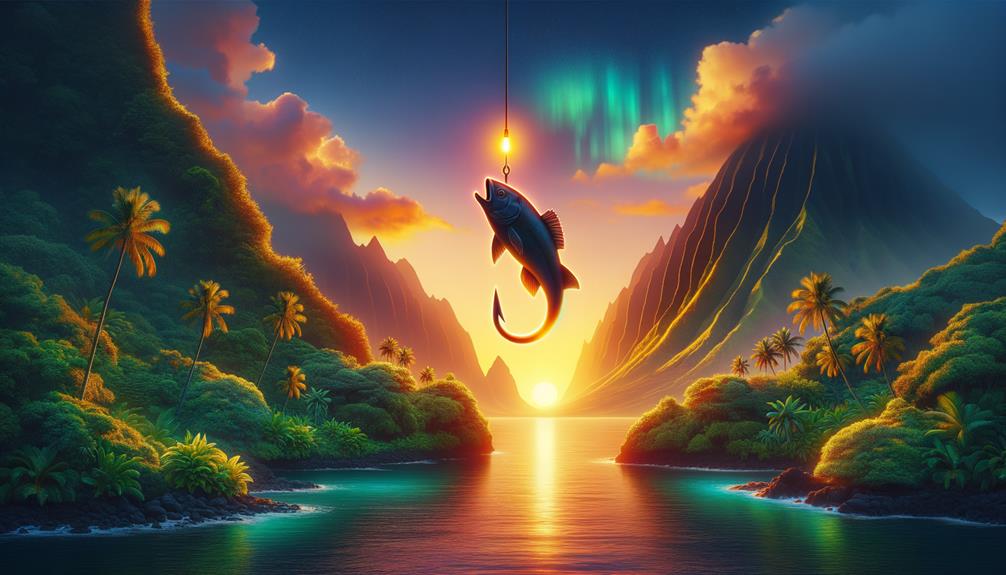
Māui’s fishhook is part of a great family of Polynesian stories about fishing up land. In Māori tradition, Māui hauls Te Ika-a-Māui—the great fish of Māui—from the ocean, and that fish becomes the North Island of Aotearoa New Zealand. The story joins ancestry, fishing knowledge, sibling rivalry, ritual responsibility, and a map that can be read as the body of a living being.
Māui across Polynesia
Māui appears in traditions from Aotearoa, Hawaiʻi, Tahiti, Tonga, Samoa, and other parts of Polynesia. He slows the sun, obtains fire, raises islands, and attempts to overcome death in different regional story cycles. Names, genealogies, helpers, motives, and outcomes vary. “The Māui myth” is therefore not one canonical biography carried unchanged from island to island.
That diversity is central to the fishing stories. Different communities identify their own islands and seascapes as Māui’s catch. The hook may have a different name or maker, and the companions may act differently. A respectful retelling identifies which tradition it is following instead of combining every version into a single pan-Polynesian adventure.
The Māori account of the great fish
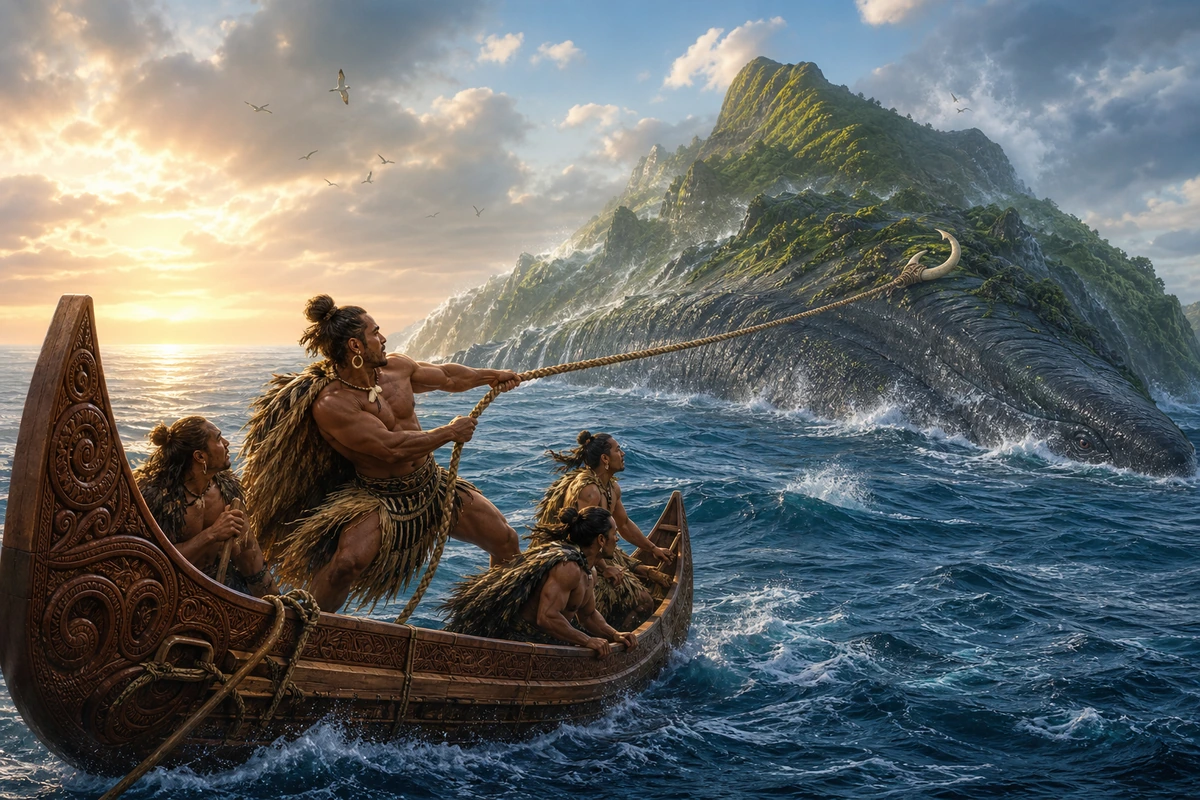
In a widely told Māori form, Māui’s older brothers do not want to take him fishing. He hides in their waka until they are far from shore, then reveals himself and persuades them to travel farther into deep water. When the brothers refuse him bait, he strikes his nose and uses his own blood. He lowers the extraordinary hook and catches something immeasurably greater than an ordinary fish.
The line tightens and Māui hauls up a vast body of land: Te Ika-a-Māui. The story is often told with the North Island’s head at the south and its tail in the far north. Regional traditions name parts of the body in ways tied to iwi histories and landscapes. Hawke’s Bay is associated with Te Matau-a-Māui, the fishhook of Māui, while other features preserve the memory of canoe, anchor, or fish.
The ancestral jawbone hook
Māui’s hook is commonly made from the jawbone of his ancestress Murirangawhenua. The material is not just a convenient piece of bone. It places ancestral relationship inside the tool itself. Māui’s success depends on knowledge and power received through kinship, then activated through courage, preparation, and karakia.
Some retellings call every curved hook pendant “Māui’s hook,” but archaeological and museum evidence is more specific. Working Māori matau were sophisticated fishing technologies made in many forms from bone, shell, stone, wood, and fiber. Their shapes function differently from a modern metal J-hook. Hei matau pendants now carry strong associations with fishing, the sea, cultural continuity, and Māui, but practical hooks and modern symbolic jewelry are not automatically the same object.
Why the land became rough
After the fish rises, Māui tells his brothers not to cut or divide it before the proper actions are completed. He leaves them, often to obtain a tohunga’s guidance or make an offering. The brothers ignore the instruction and begin hacking at the catch. The fish convulses, producing the ridges, valleys, and broken coastline of the island.
This episode is sometimes treated as a comic afterthought, but it carries the story’s ethical weight. Māui achieves the impossible through ancestral aid and controlled skill. His brothers see an immediately divisible resource. Their impatience changes the land permanently. The tale contrasts relationship and procedure with possession, haste, and appetite.
Fish, canoe, anchor, and landscape
| Element | Well-known Māori geographical reading | Important limit |
|---|---|---|
| Te Ika-a-Māui | The North Island as Māui’s great fish | Detailed body-part identifications can be regional |
| Te Waka-a-Māui | The South Island as Māui’s canoe | Names and boundaries vary across traditions |
| Te Punga-a-Māui | Rakiura/Stewart Island as an anchor stone | This belongs to a particular narrative geography |
| Te Matau-a-Māui | The Hawke’s Bay coast and Cape Kidnappers area as the hook | The name is also used more broadly today |
| The brothers’ cuts | Mountains, valleys, and an uneven coast | The story is not a failed geological theory |
A story shaped by real fishing knowledge
The scale is mythic, but the action assumes practical maritime expertise. Successful fishing requires the right hook, a strong line, knowledge of currents and depth, coordinated work in a waka, observation of seasonal patterns, and ritual preparation. Te Papa’s collections show the technical variety of Māori hooks and trolling lures and the close relation between design, material, target species, and fishing method.
The story magnifies this knowledge. Māui reads the sea, prepares a special tool, travels beyond the ordinary fishing ground, and holds a line attached to a living force below. The image of raising land does not replace navigation or fishing history; it gives those activities ancestral and cosmological scale.
Myth is not competing with geology
Te Ika-a-Māui should not be framed as an ancient “mistake” about plate tectonics. Pūrākau can encode identity, place relationships, ethics, memory, and authority without trying to be a laboratory explanation. Geological accounts ask how rock, faulting, volcanism, erosion, and time formed the islands. Māui’s story asks how people understand the land as inherited, living, named, and morally consequential.
Those modes of knowledge can exist together because they answer different questions. The myth’s enduring power lies partly in its ability to turn a familiar coastline into a remembered action. The island is not anonymous ground: it is a fish raised through ancestral skill and marked by the consequences of human behavior.
What the fishhook symbolizes today
Modern hei matau designs may represent strength, prosperity, safe travel over water, respect for the sea, or connection to Māori identity. Their meanings depend on maker, wearer, material, and context. A commercially sold “tribal hook” detached from provenance should not be treated as a dictionary of universal Polynesian symbolism.
Māui’s own hook carries a more particular narrative. It joins him to Murirangawhenua, turns fishing into the creation of habitable land, and reveals that even a wondrous catch brings obligations. Power raises the fish; restraint should govern what happens next.